Case 12164
创作高完成度历史人物海报
Prompt
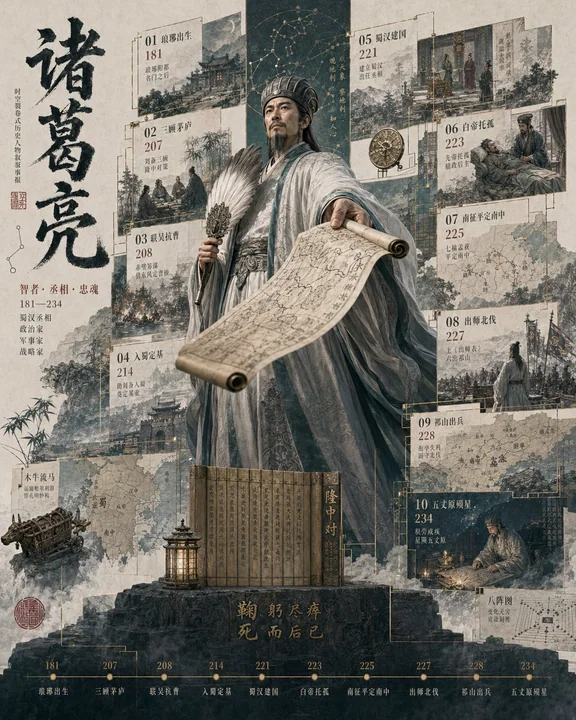
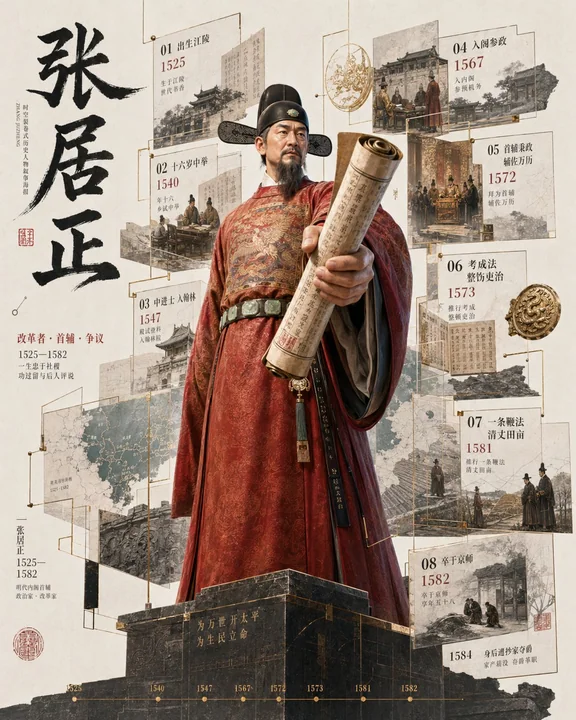
Please create a highly refined “Historical Figure Breakout Full-Body Archive / 3D Historical Breakout Biography Poster”.

[User Input]
Subject figure: [Figure Name]
Figure identity positioning: [Emperor / Famous General / Eminent Minister / Philosopher / Literary Figure / Reformer / Strategist, etc.]
Historical background: [Dynasty / Historical period]
Core keywords: [Unification / Reform / Loyalty / Unity of Knowledge and Action / Northern Expedition / Institutions / Philosophy of Mind / Golden Age, etc.]
Preferred main color palette: [Deep black-gold-red / Blue-gray-gold / Dark red-ink-gold / Iron armor deep blue, etc.]
Aspect ratio: [3:4 vertical]

This is not an ordinary historical poster, but a highly refined biographical poster centered on the structure of “central full-body 3D historical figure + breakout forward-thrust action + surrounding lightweight floating historical event clusters + bottom lightweight chronological timeline.”

At the center of the composition there must be one complete full-body, standing 3D historical figure. The figure is the most important visual focus of the entire image, with strong volume, sculptural presence, monumentality, and historical aura. Clothing, headwear, armor, patterns, belt, footwear, and accessories must all match the person’s era and status. The overall style should be realistic, weighty, and have cinematic impact. Beneath the figure there should be a light yet stable monument-style pedestal to support the character, but it must not be so heavy that it overwhelms the composition.

The figure must not merely stand normally, but must have a clearly visible “forward-thrust breakout action.” The hands, arms, or a key held prop (such as an imperial seal, edict, scroll, spear, sword, military tally, ceremonial tablet, map, manuscript, etc.) must extend toward the viewer, creating a strong 3D impact with dramatic perspective, near-large/far-small scale contrast, front-back depth, perspective compression, and a breakout effect beyond the frame. Special attention: the key prop thrusting forward must remain fully visible and clearly recognizable, and must not be cropped so that only a small portion remains.

Arrange 6 to 10 key historical milestones around the figure. Do not make them into heavy, regular, neatly tiled little cards. Instead, design them as “lightweight floating, multi-oriented, semi-transparent” historical event clusters. Each node may consist of 2 to 4 sub-fragments, including numbering, year, event title, brief explanation, a small historical scene image, and fine gold lines, open frames, node dots, annotation lines, etc. The overall feeling should resemble historical archives being deconstructed into light temporal slices floating around the figure, rather than ordinary information card layouts.

These event clusters should have varying orientations and spatial perspective relationships: some leaning left, some leaning right, some turning inward, some flipping outward, some placed higher, some lower, with front-back layering, and they may also be slightly occluded by the figure’s arm, robe hem, or weapon to create spatial depth. They should have a glass-like or acrylic-like feel, softly glowing edges, incomplete borders, and lightly offset layered stacking. The information may be detailed, but visually it must remain light and must not overpower the central figure.

On the left side of the composition, place the main title [Figure Name], using a calligraphic, stele-like, or ink-textured font with an Eastern historical character. Nearby, you may add the birth and death years, identity tag, keyword summary, and one highly condensed subtitle. The title area should feel stable, concise, and restrained, and should not be overcrowded.

At the bottom, there must be a light, concise, and finely designed horizontal timeline connecting the important years of the figure’s life and corresponding to the surrounding historical event clusters. The timeline should feel more like an exhibition guide line, a museum time scale, or a historical index line. It may use thin gold lines, small dots, concise years, small text annotations, and a few decorative nodes. Do not turn it into a heavy black horizontal bar or a huge bottom information block.

The background should be based on off-white xuan paper, antique paper, old archival paper, or a light museum wall. The overall image should be low-saturation, clean, and restrained. You may add faint map textures, silhouettes of ancient architecture, fragmentary documents, seals, gold connecting lines, annotation lines, nodes, territorial outlines, and similar elements to create a light, rational historical archive exhibition atmosphere.

The entire image must establish clear contrast:
The central figure should be heavy, realistic, three-dimensional, with strong lighting and volume;
The surrounding historical nodes should be thin, transparent, floating, softly glowing, precise, and rational;
The figure’s action should thrust forward and break the frame, with explosive spatial force;
The bottom timeline should remain light and restrained, serving only to gather and organize the information.

If different requirements conflict, prioritize the following:
1. The central figure must be a complete full-body depiction
2. The forward-thrust prop must be fully visible and have strong 3D impact
3. The surrounding event clusters must be light and floating, not heavy cards
4. The central figure should feel “heavy,” while the information system should feel “light”
5. The bottom timeline should be lightweight, clear, and not overwhelm the composition

If the model has difficulty precisely controlling a large amount of small text, prioritize keeping the figure name, years, numbering, and event titles clear; short explanatory text may be simplified appropriately or left with space reserved for later typesetting.
更多提示词

Case 9374
便利店里的持刀JK少女
(纵向 9:16)。原始高保真照片,iPhone 17 Pro 模拟,35mm 焦距,f/2.8 光圈,呈现逼真的结构深度,真实的数字颗粒。 [主体与身份锁定] 身份锁定:绝对继承图像 A 的面部拓扑结构、杏仁状眼睛坐标和心形下颌线。 头发物理:继承图像 A。 生物保真度:表皮物理特性,包括脸颊上可见的微孔、自然皮肤纹理和缎面光泽的湿润感。 表情同步:表情锁定——复制参考场景中沉思的向下凝视和中性的唇部张力。 [服装与体态] 技术描述:专业白色棉府绸纽扣衬衫,带有标准结构省道
写实风便利店日系感武士刀格子裙
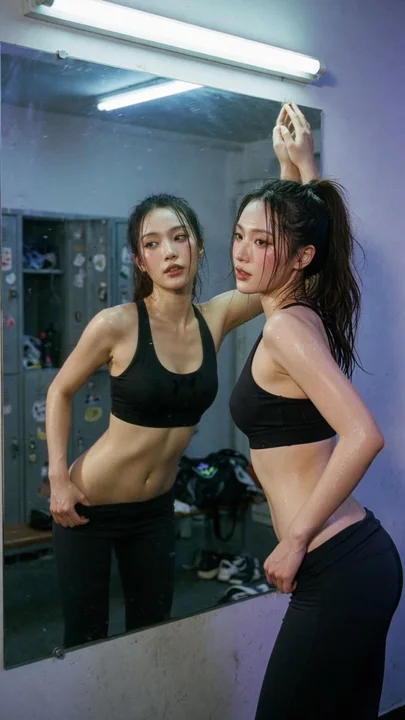
Case 9312
20岁中国女偶像健身房风采
35mm胶片摄影,写实的健身房更衣室氛围,冷白色荧光灯照明和镜面反射,真实的胶片颗粒感,高对比度,电影编辑风格,亲密的中景,20多岁性感的中国女偶像,超写实精致的中国面部特征,诱人的杏仁状狐狸眼,自然的双眼皮,高鼻梁,小巧尖锐的V型下颌线,完美无瑕的瓷白肌肤,冷象牙色底调,覆盖着微妙的运动后出汗光泽,可见的皮肤纹理、毛孔和自然的光泽在强烈的灯光下,清新性感的运动妆容,光泽的嘴唇和脸颊上的柔和红晕,长长的深棕色头发扎成凌乱的高马尾,许多湿漉漉的发丝粘在脸上和脖子上,穿着紧身黑色