Case 27270
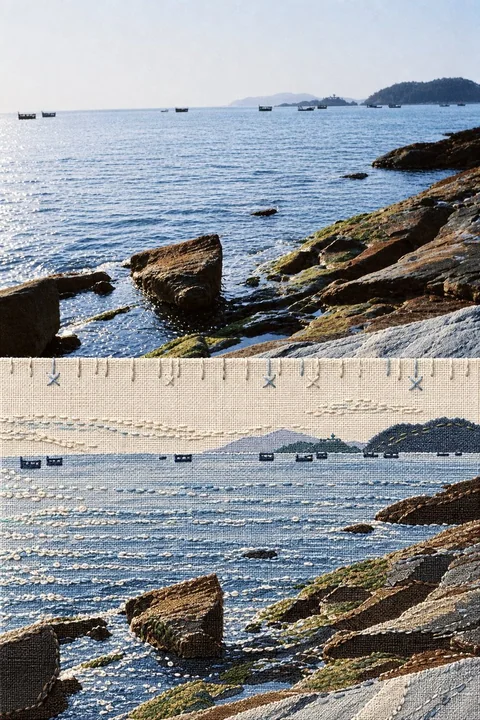
富士织物拼接风格旅行转绘海报
Prompt
Create a vertical 3:4 top-bottom comparison travel conversion poster, in the style of 'FUJI TEXTILE TRAVEL | Fuji Textile Patchwork Travel Style'. The top half fully preserves the input real Japan travel photo: maintain the original location's main subject, quantity, composition, perspective, viewing angle, spatial relationships, and natural colors, applying only slight publication-style color grading; the photo must be clearly recognizable and cannot become an illustration or a small thumbnail. In the middle, use a restrained thin white divider line. The bottom half reconstructs the same scene as a handmade textile collage with real thickness, not a photo filter nor a flat vector illustration. Use off-white coarse woven fabric as the base, strictly mapping element by element from the original photo: mountains, lake water, torii gates, temples, streets, buildings, vehicles, people, trees, or the sky are converted respectively into layered fabric pieces, felt, suede fibers, embroidery threads, chain stitches, and a small amount of bead decorations; do not add elements that do not exist in the photo out of thin air. Water surfaces and roads use continuous curved or parallel stitches to express direction, while mountains and buildings use visible thick overlapping fabric edges to express volume; window panes, eaves, torii beams, and human silhouettes use fine stitches to maintain recognizability. The materials should have handmade sewing undulations, pinholes, fiber fraying, layered shadows, and local protrusions, forming a touchable three-dimensional fabric model. The bottom half retains the main outlines, subject count, and spatial relationships of the original photo, but allows for the subjects to be split, shrunk, displaced, and recombined with negative space, and cannot be a completely isomorphic or same-density replica of the top half. Colors are refined from the photo into a limited 4 to 7 colors, each varying with the original photo, not fixed to a Mount Fuji blue-red color scheme. Retain enough off-white coarse woven fabric empty space to give the fabric components and background a sense of breathing. Must not add text, location names, logos, watermarks, AI markers, or original photo markers; must not include plastic, metal, glass, 3D game assets, pure flat cartoons, photo collages, uniform mosaic filters, irrelevant landmarks, fake Chinese, or garbled characters.

制作一张竖向3:4上下对比旅行转绘海报,风格为“FUJI TEXTILE TRAVEL|富士织物拼接旅行风”。上半完整保留输入的真实日本旅行照片:保持原图的地点主体、数量、构图、透视、观察角度、空间关系和自然色彩,只做轻微出版物调色;照片必须清晰可辨,不能变成插画或小缩略图。中间用一条克制的细白分隔线。下半把同一场景重构为具有真实厚度的手工纺织拼贴,不是照片滤镜,也不是平面矢量插画。以米白色粗织布为底,严格从原照片逐元素映射:山体、湖水、鸟居、寺庙、街道、建筑、车辆、人物、树木或天空分别转成分层布片、毛毡、绒面纤维、刺绣线、链式针迹和少量小珠装饰;不要凭空增加照片中不存在的元素。水面和道路用连续弧形或平行线迹表达方向,山体与建筑用有可见厚度的叠布边缘表达体块,窗格、屋檐、鸟居横梁和人物轮廓用精细针迹保留识别度。材料要有手工缝制的起伏、针孔、纤维毛边、层叠阴影和局部凸起,形成可触摸的立体织物模型。下半保留原图的主要轮廓、主体数量和空间关系,但允许将主体拆分、缩小、错位和重新留白组合,不能与上半完全同构、同密度复刻。色彩从照片提炼为有限的4至7色,每张随原图变化,不固定使用富士山蓝红配色。保留足够米白粗织布空场,让织物构件与背景有呼吸感。不得添加文字、地点名、Logo、水印、AI角标或原图角标;不得出现塑料、金属、玻璃、3D游戏资产、纯平面卡通、照片拼贴、统一马赛克滤镜、无关地标、假中文和乱码。
更多提示词
Case 30
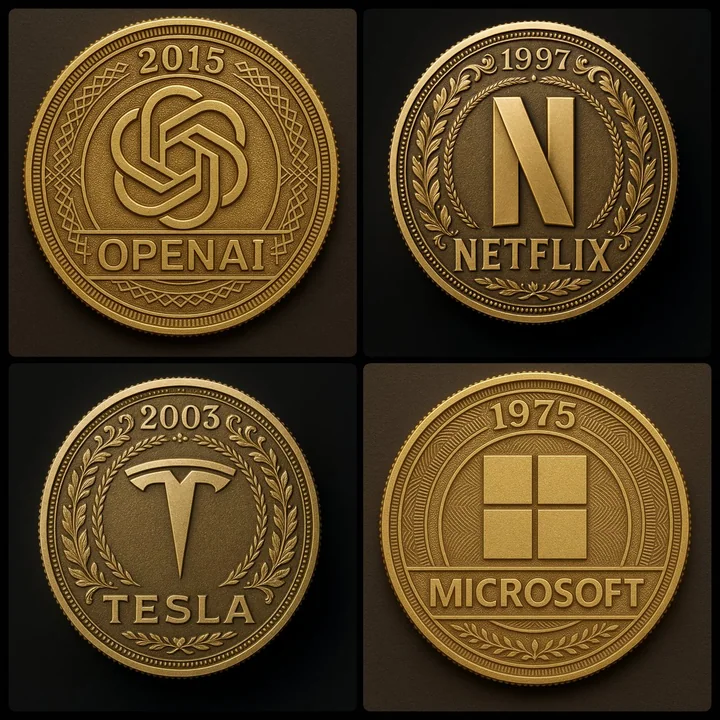
公司金币
提示:一张高分辨率的照片,展示一枚金币,中央印有[公司名称]的标志。硬币顶部应刻有年份[年份]。包括精细的雕刻细节、装饰性边框图案以及真实的硬币纹理,如锯齿边缘和哑光质感。
photography

Case 27348
一张商K女郎日常照
A photorealistic cinematic vertical nightlife portrait of a clearly adult young woman in her early twenties, around 20 years old, standing inside an upscale private karaoke lounge or nightclub room and waving directly toward the camera. Her

Case 17465
极简利落方盒链条包通勤送礼搜索主图
轻奢风