Case 27530
手工立体层叠纸艺绘本风格转换
Prompt
Use the single uploaded photograph as the sole content source. Transform it into one finished handcrafted layered-paper storybook scene. Output only the transformed image—do not include the original photograph, a before-and-after comparison, split layout, collage, caption, explanation, border, or mockup. Preserve the source image’s aspect ratio and general framing.

Faithfully preserve the main subject’s identity cues, age category, gender presentation, skin tone, hairstyle, facial hair, glasses, expression, gaze direction, pose, body orientation, clothing categories, garment colors, accessories, and interaction with important objects. Keep the exact number of principal people and preserve their spatial relationships. Retain all objects necessary to understand the action. Do not add, remove, duplicate, or replace important subjects, limbs, tools, garments, or props.

Redesign the person as a charming contemporary paper-cut storybook character with a slightly enlarged head, softly simplified facial anatomy, compact proportions, expressive dark eyes, clean eyebrows, a small nose and mouth, subtle rosy cheeks, and a warm natural expression matching the source. Preserve distinguishing facial structure, hair silhouette, facial hair, eyewear, and clothing so the subject remains recognizable. Adults must retain an adult appearance; avoid infant proportions, extreme chibi anatomy, oversized sparkling eyes, or a generic identical doll face.

Construct the entire image as a dimensional handmade paper diorama using layered cut cardstock, fibrous handmade paper, lightly embossed paper, and occasional soft felt-like paper surfaces. Every person, object, plant, architectural element, and landscape feature must visibly consist of overlapping cut-paper pieces. Show tactile paper grain, slightly irregular hand-cut edges, folded planes, stacked layers, shallow relief, clean silhouettes, and soft contact shadows between layers. Avoid photorealistic materials, plastic toys, clay, crochet, glossy CGI, flat vector graphics, or smooth digital painting.

Identify the photograph’s dominant everyday action and its most meaningful object, then turn that relationship into a gentle visual metaphor. The metaphor must grow directly from the source rather than introduce an unrelated fantasy. For example, fabric may become folded mountains, food may expand into an orchard, water may form a miniature garden landscape, or the contents of a bag may become a tiny symbolic world. Use this principle adaptively—do not copy these examples when they do not match the uploaded photograph. Preserve the original action exactly while allowing the key object or surrounding surface to unfold into a coherent miniature paper world that expresses the action’s emotional theme.

Keep the main character large and dominant in the foreground. Surround the character’s silhouette with a narrow warm-ivory paper edge, like a raised die-cut storybook figure. Integrate this figure naturally into the layered scene rather than making it look pasted onto an unrelated background. Preserve the source setting’s recognizable structure—such as a room, balcony, kitchen, garden, doorway, table, or landscape—but simplify it into broad paper shapes. Remove incidental clutter, unreadable labels, duplicate objects, and distracting background details. Expand only the central storytelling element into an imaginative environment.

Use strong foreground, middle-ground, and background separation. Place small paper elements at different depths to create a theatrical miniature-set effect: foreground foliage or props, the main subject and action in the middle ground, and simplified architecture, hills, trees, clouds, or distant scenery behind them. Use overlapping shapes rather than realistic perspective detail. Keep the composition balanced and readable, with the principal action remaining the clearest focal point.

Use a warm, muted, nature-inspired palette derived from the source photograph: sage and olive greens, mustard, terracotta, dusty blue, cream, warm brown, charcoal, and restrained pastel accents. Preserve signature clothing and object colors. Use broad matte color fields with subtle variations from paper fibers, avoiding neon colors and photographic gradients. Light the scene with warm diffused daylight from the same general direction as the source, producing soft shadows beneath raised paper layers and a cozy handcrafted atmosphere.

Render plants, trees, clouds, mountains, waves, furniture, textiles, and small decorative objects as simplified cut-paper forms with enough detail to remain identifiable. Use repeated leaf shapes, scalloped clouds, angular folded mountains, layered waves, tiny buildings, and miniature props only when relevant to the source story. Keep hands complete and naturally connected to objects. Preserve occlusion and contact accurately so tools, containers, clothing, and environmental elements remain physically understandable.

The finished image should feel like a premium children’s picture-book illustration, stop-motion paper theater, and collectible dimensional papercraft artwork: imaginative but grounded in the uploaded moment, tactile, warm, polished, emotionally gentle, and rich in small narrative details. Avoid photorealism, anime rendering, plastic 3D characters, smooth vector art, watercolor, yarn embroidery, malformed hands, duplicated limbs, changed actions, missing props, unrelated fantasy objects, excessive clutter, text, logos, signatures, watermarks, and visible comparison layouts. Output only the completed transformed paper-diorama image.

以上传的单张照片为唯一内容来源。将其转换成一个完成的手工叠层纸艺绘本场景。仅输出转换后的图像——不要包含原始照片、前后对比图、分屏布局、拼贴画、标题、解释、边框或模型图。保留源图像的长宽比和大致构图。

忠实保留主角的身份线索、年龄类别、性别呈现、肤色、发型、面部毛发、眼镜、表情、注视方向、姿势、身体取向、服装类别、服装颜色、配饰以及与重要物品的互动。保持主要人物的确切数量并保留其空间关系。保留理解动作所需的所有物品。不要添加、删除、重复或替换重要的主体、肢体、工具、服装或道具。

将人物重新设计为迷人的当代剪纸绘本角色,头部略微放大,面部解剖结构柔和简化,比例紧凑,拥有富有表现力的深色眼睛、整洁的眉毛、小鼻子和小嘴巴、微妙的红润脸颊,以及与来源匹配的温暖自然表情。保留独特的面部结构、发型轮廓、面部毛发、眼镜和服装,使主体保持可辨识性。成年人必须保持成年外观;避免婴儿比例、极端的二头身解剖结构、过大的闪烁眼睛或通用的相同娃娃脸。

将整个图像构建为一个维度的手工纸艺透视模型,使用层叠的卡纸、纤维手工纸、轻微压花的纸张以及偶尔出现的柔软毡状纸面。每个人、物体、植物、建筑元素和景观特征都必须明显由重叠的剪纸片组成。展示触觉纸纹、略微不规则的手切割边缘、折叠平面、堆叠层、浅浮雕、清晰的轮廓以及层与层之间的柔和接触阴影。避免写实材料、塑料玩具、粘土、钩针、光泽的CGI、扁平矢量图形或平滑的数字绘画。

识别照片中占主导地位的日常动作及其最有意义的物体,然后将这种关系转化为柔和的视觉隐喻。隐喻必须直接源于素材,而不是引入无关的幻想。例如,织物可能变成褶皱的山脉,食物可能扩展成一间果园,水可能形成微型花园景观,或者包里的内容物可能变成一个微小的象征世界。自适应地使用这一原则——当这些例子与上传的照片不匹配时,不要复制它们。准确保留原始动作,同时允许关键物体或周围表面展开成一个连贯的微型纸艺世界,以表达动作的情感主题。

保持主角在前景中高大且占主导地位。在人物轮廓周围包围一圈窄窄的暖象牙色纸边,就像一个凸起的模切绘本人物。将此形象自然地融入层叠场景中,而不是使其看起来像是粘贴在无关背景上的。保留源场景的可辨识结构——如房间、阳台、厨房、花园、门口、桌子或风景——但将其简化为宽阔的纸张形状。移除偶然的杂乱、无法辨认的标签、重复的物体和分散注意力的背景细节。仅将核心叙事元素扩展为富有想象力的环境。

使用强烈的背景、中景和背景分离。将小的纸张元素放置在不同的深度,以创造剧场式的微型布景效果:前景的植物或道具,中景的主角和动作,以及他们身后简化的建筑、小山、树木、云朵或远景。使用重叠的形状而不是写实的透视细节。保持构图平衡且易读,主要动作保持为最清晰的焦点。

使用源于原始照片的温暖、柔和、受自然启发的色调:鼠尾草绿和橄榄绿、芥末黄、陶土色、灰蓝色、奶油色、暖褐色、木炭色和内敛的粉彩色调。保留标志性的服装和物体颜色。使用具有来自纸张纤维细微变化的宽阔哑光色块,避免霓虹色和摄影渐变。用来自与光源大致相同方向的温暖漫射日光照射场景,在升起的纸层下方产生柔和的阴影,营造出舒适的手工氛围。

将植物、树木、云朵、山脉、波浪、家具、纺织品和小型装饰物渲染为简化的剪纸形式,并带有足以保持可辨识性的细节。仅在与源故事相关时使用重复的叶子形状、扇形云朵、棱角分明的折叠山脉、层叠的波浪、微型建筑和微型道具。保持双手完整并与物体自然连接。准确保留遮挡和接触,使工具、容器、服装和环境元素保持物理上的可理解性。

成品图像应该感觉像是一幅高级儿童图画书插图、定格纸艺剧场和具有收藏价值的立体纸艺作品:充满想象力但植根于上传的时刻,具有触感,温暖,精致,情感温柔,且富有微小的叙事细节。避免写实主义、动漫渲染、塑料3D角色、平滑的矢量艺术、水彩、毛线绣、变形的手、重复的肢体、改变的动作、缺失的道具、无关的幻想物品、过度的杂乱、文本、徽标、签名、水印和可见的对比布局。仅输出完成的转换后的纸艺透视图。
مطالب أخرى
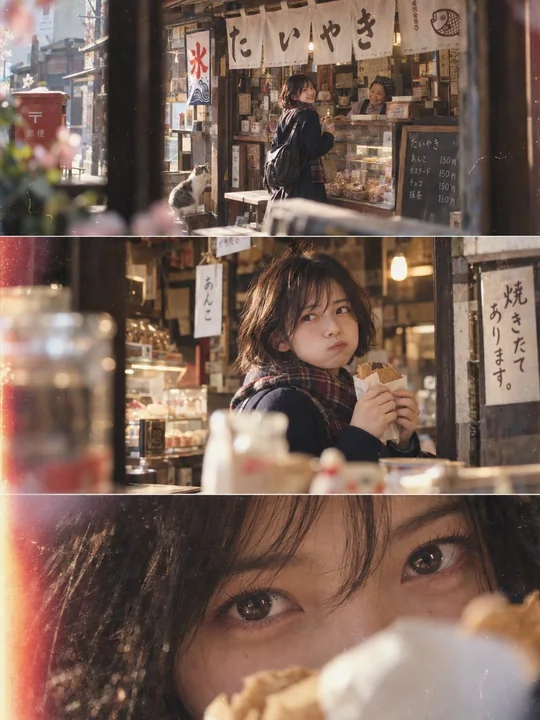
Case 27562
日系胶片三格分镜少女街拍朦胧美学
Japanese film photography, three storyboard frames arranged vertically in one image, all with different shot sizes and angles, continuous motion. Close-up out of focus, occlusion, wide angle, perspective, shallow depth of field, hazy gradie

Case 15943
刺绣木刻纹理拼贴全身人像剪影
拼贴画刺绣风剪影感民间风碎裂感