Case 24396
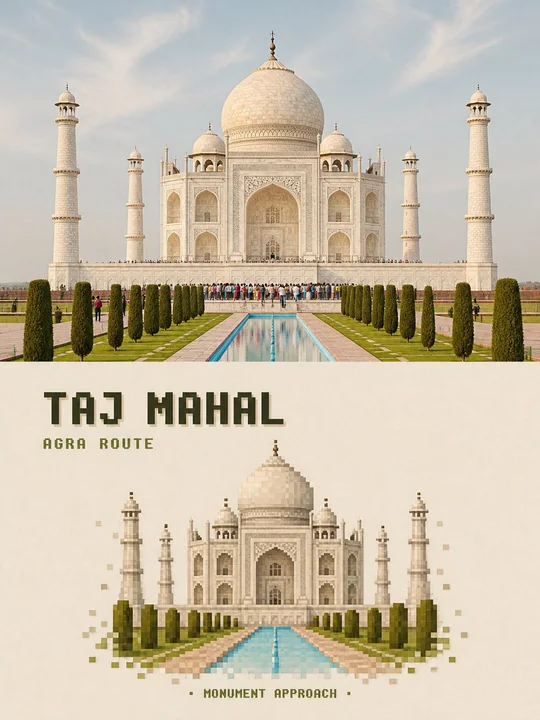
高级像素游戏旅行海报
Prompt
Please turn every travel photo I upload into an independent high-end pixel game travel poster. No multi-photo stitching, one photo corresponds to one complete finished product.

The overall composition adopts a strict 3:4 vertical layout. The screen is divided into two nearly 1:1 areas at the top and bottom, using a straight, clear, and clean horizontal boundary in the middle. Only output the front of the poster, do not generate photo frames, walls, handheld displays, or Mockups.

### Top Half: High-Fidelity Original Photography

The upper half must faithfully preserve the original photo.

Accurately maintain the subject identity and quantity in the photo, person or animal poses, vehicle and boat directions, architectural structures, topographic relationships, observation angles, spatial perspective, front-and-back occlusion, real materials, natural light and shadow, and the original color atmosphere.

Only perform slight, restrained travel magazine, art publication, or photography exhibition level color grading, and add very thin film grain. The upper half must still clearly be a real photo.

不得将照片插画化,不得移动、替换、增删或放大主体,不得重塑建筑、镜像场景、改变人物动作或使用模糊照片填充画幅。

### Bottom Half: Subject Extraction-Style Pixel Game Redrawing

Do not fully pixelate the entire photo.

First, understand the single visual subject in the photo most worth the viewer getting closer to, operating, entering, or continuing to explore, for example:

- A landmark building with a clear outline
- A ship, vehicle, or other travel transportation tool
- A character or a group of characters with clear movement relationships
- A door, a stall, a bridge, or an independent travel object
- A section of road, steps, or navigation path that can represent the photo's story

Choose only one main visual anchor.

Retain the subject's most recognizable outline, posture, orientation, key structure, and iconic colors, and reconstruct it into an aesthetically mature independent travel game character, location, or interactive object.

The subject usually occupies about 35%–60% of the width and about 25%–45% of the height of the bottom area, placed in the lower center or naturally offset according to the direction of the original scene.

Do not redraw according to the original photo's full framing, original proportions, and original background density.

### Environmental Reduction

Keep only one to three environmental clues that can explain the location, direction, and action relationships, such as:

- A short section of road, track, steps, or track
- Two or three building facades or mountain fragments
- A small amount of trees, street lamps, guardrails, or shorelines
- Several sets of water ripples, reflections, or ground color blocks
- A very small distant figure, vehicle, or ship as a scale prompt

Delete other tourists, repeated window panes, dense vegetation, billboards, cluttered traffic, complex skies, irrelevant buildings, and photography noise.

The bottom half retains at least about 50%–65% of continuous warm off-white paper surface. Allow blank space to directly represent sky, air, water surface, distance, streets, or game areas that have not yet been explored.

### Pixel Medium

Rebuild the subject using square or near-square pixel blocks with clear edges.

- Use smaller, denser pixel blocks at key points of subject recognition.
- Use medium-sized pixel blocks for the main volume of the subject.
- Gradually reduce pixel density for roads, water ripples, vegetation, reflections, and distant views.
- The interior of the subject is relatively complete, and the exterior breaks apart, misaligns, scatters, and disappears into the paper white frame by frame along the real outline, road direction, water flow, mountain trend, or movement direction.
- Outlines must have clear stepped hard edges.
- There can be a small amount of paper gaps between pixel blocks.

This is not a photo mosaic filter, not an overall reduction in photo resolution, nor a blurred pixelated, cyber glitch, or data corruption effect.

The overall should be like an independent travel game with mature art design: a real location compressed into a small level that can be approached, entered, and continued to be explored.

### Game Text Information

Text is not tiny editorial notes, but part of the game scene information.

Based on the location, subject, and action that can be confirmed in the photo, extract and keep only three layers of English information:

1. Main Title: Location, landmark or scene name, 1–3 English words.
2. Area Subtitle: Route, area or scene type, 1–3 English words.
3. Status Information: Real action or state happening in the photo, 2–4 English words.

If the specific location cannot be confirmed, do not invent place names, coordinates, or dates; use the subject and scene names.

The main title is the second visual center of the bottom half:

- Use 8-bit or 16-bit pixel display fonts truly built on a grid.
- All uppercase, thick glyphs, square ends, no anti-aliasing.
- Width usually occupies about 35%–55% of the bottom area.
- Must be clearly readable when viewed normally, cannot be shrunk into technical side notes.
- Can use dark character faces extracted from photos, and add a one-grid light-colored or characteristic-colored hard-edged pixel drop shadow.
- Long titles are allowed to be compactly divided into two lines.

Area subtitles are about 35%–45% of the main title font size, like map area categories.

Status information can be smaller, but must still be readable when viewed normally, and naturally arranged along the subject baseline, road, track, or water ripple.

The text must use the same pixel grid, limited color palette, and hard-edge mechanism as the image, looking as if it naturally grew out of the game scene rather than a common monospaced font pasted later.

Do not generate other text, numbers, author names, signatures, accounts, brands, logos, QR codes, or URLs.

### Color

The color scheme is extracted entirely from the current photo and compressed into about 6–12 main color levels.

Retain the most recognizable colors of the subject and use adjacent light and dark colors to establish volume. One highly saturated color that truly exists in the photo can be retained as a visual jump point.

Off-white paper must be the largest color block in the bottom half.

Do not fixedly use neon blue-purple, cyber color schemes, game console high-saturation colors, or sunset orange unrelated to the original photo.

### Overall Vibe

Authentic, quiet, with a sense of life, while also having a desire for game exploration.

Like an ordinary moment during a trip, suddenly saved as an area unlock screen, location map, or action save in an independent game.

Gamification comes from subject extraction, pixel structure, level-style space, and text information hierarchy, rather than stacking HUDs and game icons.

### Mandatory Avoidance

Avoid: full-scene pixel redraw, same-crop same-scale redraw, complete pixel background, photo mosaic filter, overall low resolution, blurry pixelation, smooth vector illustration, generic pixel landscape, generic landmark icon, giant HUD, health bars, buttons, dialogue boxes, inventory panels, commercial game logo, voxel 3D, Minecraft blocks, cyber glitch, data corruption, neon palette, invented landmark, invented people, altered architecture, excessive text, tiny unreadable title, ordinary typewriter font, author name, signature, watermark, pixels crossing the horizontal divider.

请将我上传的每一张旅行照片分别制作成一张独立的高级像素游戏旅行海报。不要多图拼接,一张照片对应一张完整成品。

整体采用严格的 3:4 竖版构图。画面上下分为两个接近 1:1 的区域,中间使用笔直、清楚、干净的水平边界。只输出海报正面,不生成相框、墙面、手持展示或 Mockup。

### 上半部分:高保真原始摄影

上半部分必须忠实保留原始照片。

准确保持照片中的主体身份与数量、人物或动物姿态、车辆和船只方向、建筑结构、地形关系、观察角度、空间透视、前后遮挡、真实材质、自然光影和原有色彩氛围。

只进行轻微、克制的旅行杂志、艺术出版物或摄影展级调色,并加入极薄胶片颗粒。上半部分仍然必须明确是一张真实照片。

不得将照片插画化,不得移动、替换、增删或放大主体,不得重塑建筑、镜像场景、改变人物动作或使用模糊照片填充画幅。

### 下半部分:主体提炼式像素游戏转绘

不要将整张照片完整像素化。

首先理解照片中最值得观者靠近、操作、进入或继续探索的单一视觉主体,例如:

- 一座具有明确轮廓的地标建筑
- 一艘船、车辆或其他旅行交通工具
- 一个人物或一组动作关系清楚的人物
- 一扇门、一个摊位、一座桥或一个独立旅行物件
- 一段能够代表照片故事的道路、台阶或航行路径

只选择一个主要视觉锚点。

保留主体最具识别度的轮廓、姿态、朝向、关键结构和标志性色彩,将它重新构建成审美成熟的独立旅行游戏角色、地点或可交互物件。

主体通常占下半区域宽度约 35%–60%、高度约 25%–45%,放置在中央偏下或依据原场景方向自然偏移。

不要按照原照片的完整取景、原比例和原背景密度重新绘制。

### 环境删减

只保留一至三条能够解释地点、方向和行动关系的环境线索,例如:

- 一小段道路、铁轨、台阶或航迹
- 两三块建筑立面或山体碎片
- 少量树木、街灯、护栏或岸线
- 几组水纹、倒影或地面色块
- 一个很小的远处人物、车辆或船只作为尺度提示

删除其他游客、重复窗格、密集植被、广告牌、杂乱交通、复杂天空、无关建筑和摄影噪声。

下半部分至少保留约 50%–65% 连续的温暖米白纸面。允许空白直接代表天空、空气、水面、距离、街道或尚未探索的游戏区域。

### 像素媒介

使用边缘清楚的正方形或近似正方形像素块重新搭建主体。

- 主体识别关键处使用较小、较密的像素块。
- 主体主要体量使用中等尺寸像素块。
- 道路、水纹、植被、倒影和远景逐渐降低像素密度。
- 主体内部相对完整,外围沿真实轮廓、道路方向、水流、山势或运动方向逐格断开、错位、散落并消失到纸白。
- 轮廓必须具有明确的台阶状硬边。
- 像素块之间可以有少量纸面缺口。

这不是照片马赛克滤镜,不是将照片整体降低分辨率,也不是模糊像素化、赛博故障或数据损坏效果。

整体应像一款具有成熟美术设计的独立旅行游戏:真实地点被压缩成一个可以靠近、进入和继续探索的小型关卡。

### 游戏文字信息

文字不是微小的编辑注释,而是游戏场景信息的一部分。

根据照片中能够确认的地点、主体和动作,提炼且只保留三层英文信息:

1. 主标题:地点、地标或场景名称,1–3 个英文单词。
2. 区域副标题:路线、区域或场景类型,1–3 个英文单词。
3. 状态信息:照片中正在发生的真实动作或状态,2–4 个英文单词。

如果无法确认具体地点,不得虚构地名、坐标或日期,应使用主体和场景名称。

主标题是下半部分的第二视觉中心:

- 使用真正建立在方格网格上的 8-bit 或 16-bit 像素显示字体。
- 全部大写,字形厚实、端点方正、无抗锯齿。
- 宽度通常占下半区域约 35%–55%。
- 正常查看时必须清楚可读,不能缩成技术边注。
- 可使用从照片提取的深色字面,并加入一格浅色或特征色硬边像素投影。
- 长标题允许紧凑地分成两行。

区域副标题约为主标题字号的 35%–45%,像地图区域分类。

状态信息可以更小,但正常查看仍须可读,并沿主体基线、道路、航迹或水纹自然排列。

文字必须与画面使用相同的像素网格、限色色盘和硬边机制,像从游戏场景中自然长出来,而不是后期贴上的普通等宽字体。

不得生成其他文字、数字、作者名、签名、账号、品牌、Logo、二维码或网址。

### 色彩

配色完全从当前照片提取并压缩为约 6–12 个主色阶。

保留主体最具识别度的颜色,并使用相邻深浅色建立体积。可保留一处照片中真实存在的高饱和颜色作为视觉跳点。

米白纸面必须是下半部分的最大色块。

不要固定使用霓虹蓝紫、赛博配色、游戏机高饱和色或与原照片无关的夕阳橙。

### 整体气质

真实、安静、有生活感,同时带有游戏探索欲。

像旅行途中一个普通瞬间,突然被保存成独立游戏中的区域解锁画面、地点地图或行动存档。

游戏化来自主体提炼、像素结构、关卡式空间与文字信息层级,而不是堆叠 HUD 和游戏图标。

### 强制避免

Avoid: full-scene pixel redraw, same-crop same-scale redraw, complete pixel background, photo mosaic filter, overall low resolution, blurry pixelation, smooth vector illustration, generic pixel landscape, generic landmark icon, giant HUD, health bars, buttons, dialogue boxes, inventory panels, commercial game logo, voxel 3D, Minecraft blocks, cyber glitch, data corruption, neon palette, invented landmark, invented people, altered architecture, excessive text, tiny unreadable title, ordinary typewriter font, author name, signature, watermark, pixels crossing the horizontal divider.
Другие промпты

Case 21402
极致写实晨光花园少女写真
Promptthe uploaded reference image as the ONLY face reference. Preserve the girl's facial identity 100% accurately, including her facial proportions, porcelain skin, expressive eyes, naturally thick eyebrows, delicate nose, soft glossy lips

Case 21965
埃隆马斯克手持纸杯蛋糕的搞怪科技瞬间
Elon! Show us the Cupcake...i mean the algo...i mean both...ok, i show the cupcake prompt and you the Algo source. Deal? 🧁 埃隆!给我们看看纸杯蛋糕……我是说算法……我是说两个都看……好吧,我展示纸杯蛋糕的提示,你展示算法的源代码。成交吗?🧁
创意马斯克科技搞怪甜点