Case 25669
高端大写字母垂直切片排版海报设计
Prompt
【MAIN WORD】: {4–8 letter uppercase keyword}
【PROJECT TYPE】: {campaign / product launch / exhibition / editorial poster}
【BRAND / PROJECT】: {name}
【PHOTO SUBJECT】: {one complete photographic scene}
【BACKGROUND COLOR】: {color}
【IMAGE PALETTE】: {main colors}
【TYPE STYLE】: {condensed grotesk / slab serif / Didone serif}
【TOP LEFT】: {date / time / location}
【TOP RIGHT】: {short statement}
【BOTTOM LEFT】: {supporting details}
【BOTTOM RIGHT】: {brand / project name}
【FORMAT】: 9:16 vertical

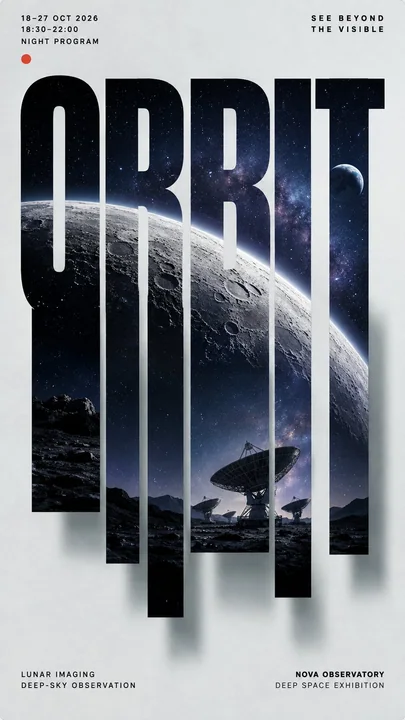
Create a high-end editorial poster built around **vertical sliced typography**.

Place 【MAIN WORD】 at the center as the dominant visual, occupying about 75–85% of the poster width. Keep the word bold, clear and readable at thumbnail size.

Embed **one single continuous photograph** of 【PHOTO SUBJECT】 inside the entire word. Every letter should reveal a different part of the same image, with horizons, objects, people, light, branches, roads or material edges connecting naturally across the letters.

Keep roughly the upper 40–45% of the letterforms intact. Extend selected lower strokes downward into 5–7 vertical slices with varied short, medium and long lengths. The slices must grow naturally from the original letters, not become unrelated rectangles or barcode-like strips.

Continue the same photograph through every extended slice. Place the strongest visual focus around the central letters and use one clear continuous feature to connect the composition.

Add a subtle soft shadow behind the typography, slightly offset toward the lower right, creating a restrained floating-paper effect.

Use a clean 【BACKGROUND COLOR】 background with generous negative space. Keep most visual complexity inside the typography and use 【IMAGE PALETTE】 for the embedded photography.

Arrange meaningful supporting information around the main visual:

Top left: 【TOP LEFT】
Top right: 【TOP RIGHT】
Bottom left: 【BOTTOM LEFT】
Bottom right: 【BOTTOM RIGHT】

Use clean modern typography for secondary information. The final image should feel like a finished campaign, exhibition, product-launch or editorial poster, not a template demonstration.

【MAIN WORD】:{4–8 个大写字母关键字}
【PROJECT TYPE】:{活动 / 产品发布 / 展览 / 编辑海报}
【BRAND / PROJECT】:{名称}
【PHOTO SUBJECT】:{一个完整的摄影场景}
【BACKGROUND COLOR】:{颜色}
【IMAGE PALETTE】:{主要颜色}
【TYPE STYLE】:{窄体无衬线体 / 粗衬线体 / 迪多尼衬线体}
【TOP LEFT】:{日期 / 时间 / 地点}
【TOP RIGHT】:{简短声明}
【BOTTOM LEFT】:{支持细节}
【BOTTOM RIGHT】:{品牌 / 项目名称}
【FORMAT】:9:16 垂直

创建一个以**垂直切片文字排版**为核心的高端编辑海报。

将【MAIN WORD】置于中心作为主视觉,占据海报宽度的大约 75–85%。保持单词加粗、清晰,在缩略图大小下也易于阅读。

在整个单词内部嵌入【PHOTO SUBJECT】的**单张连续照片**。每个字母应展示同一图像的不同部分,地平线、物体、人物、光线、树枝、道路或材质边缘在字母之间自然连接。

保持字母形状上方大约 40–45% 的部分完整。将选定的下部笔画向下延伸成 5–7 个长度不一(短、中、长)的垂直切片。切片必须从原始字母中自然生长,而不是变成无关的长方形或条形码状条纹。

在每个延伸的切片中继续展示同一张照片。将最强的视觉焦点放在中心字母周围,并使用一个清晰的连续特征来连接构图。

在排版背后添加微妙的软阴影,向右下方稍微偏移,营造出一种克制的纸张漂浮效果。

使用干净的【BACKGROUND COLOR】背景,留出大量的负空间。将大部分视觉复杂性保留在排版内部,并在嵌入的照片中使用【IMAGE PALETTE】。

在主视觉周围布置有意义的辅助信息:

左上:【TOP LEFT】
右上:【TOP RIGHT】
左下:【BOTTOM LEFT】
右下:【BOTTOM RIGHT】

为次要信息使用干净的现代排版。最终图像应感觉像是一个完成的活动、展览、产品发布或编辑海报,而不是模板演示。