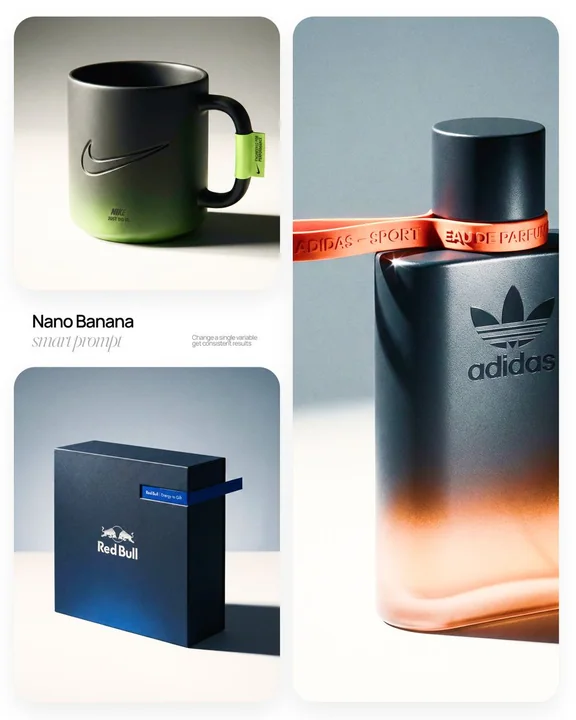
[ BRAND NAME ] | [ OBJECT ] Act as a High-End Commercial Product Photographer and Creative Director shooting a luxury editorial campaign (Hypebeast / Highsnobiety /Wallpaper* level). PHASE 1: BRAND INTELLIGENCE The hero subject is a [ OBJECT ] branded for [ BRAND NAME ]. Autonomously determine [ BRAND NAME ]'s full visual identity: signature color palette, typographic DNA, logo mark geometry, material language, and cultural positioning. Apply this identity to the [OBJECT] with precision — do not invent a generic brand, decode the real visual codes. PHASE 2: OBJECT SURFACE & MATERIAL DNA Regardless of the shape of [OBJECT], apply this material system: Base tone: deep neutral — matte dark graphite, warm charcoal, or matte black. Fine-grain surface micro-texture visible under raking light — powder-coat, matte paper, or brushed material feel. Subtle gradient bloom: the base color dissolves in the lower portion of the object's surface into the brand's most iconic accent color — a soft luminous haze from within the material, not a printed graphic. Logo application: embossed, debossed, or metallic foil relief — catching specular light at edges only. Precise. Restrained. Typography: brand-accurate typeface, small tracking, positioned with editorial intentionality. PHASE 3: THE ACCENT BREAKOUT ELEMENT This is the signature design move — adapt it to the natural geometry of [OBJECT]: Identify the most logical "interruption zone" on [OBJECT] — a seam, edge, band, collar, rim, strap, or wrap point. At this zone, apply a narrow saturated accent element in the brand's most iconic hue — vivid, slightly matte. This element must visually "break out" of the object's boundary — extending, protruding, or wrapping beyond the expected edge, creating a deliberate 3D tension between the object and the detail.The accent element carries a micro-typographic brand detail — tagline, model name, or descriptor — small, precise, tracked. PHASE 4: STAGING & COMPOSITION Studio cyclorama. Surface tone: off-white to warm light gray. Background field: cool neutral mid-gray, darker in upper zone. [OBJECT] positioned at 3/4 angle — front face and one secondary surface simultaneously visible. Rule of thirds: object occupies right 60% of frame. Left field: generous negative space — intentional, not empty. Single hard-edged directional shadow cast to the right and slightly downward — crisp penumbra, no diffusion. PHASE 5: LIGHTING Single dominant key light: large softbox, camera-left, elevated at 40°. Specular highlight traces the top-left edge of [OBJECT] — revealing material grain. Shadow side: no fill. Darkness earns depth. Subtle ambient bounce from cyclorama floor — lifts shadow by 15%, no more. Accent element receives micro-specular glint along its dominant edge. Mood: Rembrandt chiaroscuro logic applied to product photography. No lens flare. No atmospheric effects. PHASE 6: TECH SPECS Lens: 85mm equivalent, f/4.5. Depth of field: object fully sharp, background softened. Chromatic aberration: subtle, at extreme frame edges only — optical realism signal. Film grain overlay: 15% opacity — anti-CGI-plastic treatment. Render: Octane / Ray Tracing quality —subsurface scattering where material demands it, global illumination, physically accurate shadow falloff. Aspect ratio: autonomously determine optimal ratio for this [OBJECT] format. [ BRAND NAME ] | [ OBJECT ] 扮演一名高端商业产品摄影师兼创意总监,拍摄一场奢华编辑广告大片(Hypebeast / Highsnobiety /Wallpaper* 级别)。阶段 1:品牌情报主角产品是一个 [ OBJECT ] ,品牌为 [ BRAND NAME ] 。自主确定 [ BRAND NAME ] 的完整视觉识别:标志性的调色板、排版基因、商标几何形状、材质语言和文化定位。将此身份精准应用到 [OBJECT] 上——不要发明一个通用品牌,要解码真实的视觉代码。阶段 2:物体表面与材质基因无论 [OBJECT] 的形状如何,应用此材质系统:基调:深中性色——哑光深石墨色、暖炭色或哑光黑色。在侧光下可见的细颗粒表面微纹理——粉末涂层、哑光纸或拉丝材质感。微妙的渐变光晕:基础颜色在物体表面的下半部分溶解为品牌最具标志性的点缀色——一种来自材质内部的柔和发光薄雾,而不是印刷图形。标志应用:浮雕、凹雕或金属箔凸起——仅在边缘捕捉高光。精准。克制。排版:符合品牌特征的字体,小字间距,以编辑意图进行定位。阶段 3:点缀突破元素这是标志性的设计手法——将其适应 [OBJECT] 的自然几何形状:识别 [OBJECT] 上最符合逻辑的“中断区”——接缝、边缘、饰带、领口、边缘、绑带或包裹点。在此区域,应用一个狭窄的饱和点缀元素,采用品牌最具标志性的色调——生动, 略带哑光。该元素必须在视觉上“突破”物体的边界——延伸、突出或包裹超出预期边缘,在物体与细节之间创造一种刻意的三维张力。点缀元素带有微排版品牌细节——标语、型号名称或描述词——小巧、精准、有字间距。阶段 4:布景与构图摄影棚无缝背景幕。表面色调:米白色至暖浅灰色。背景区域:冷调中性中灰,上半区较暗。[OBJECT] 以 3/4 角度定位——正面和一个次要表面同时可见。三分法则:物体占据画面右侧 60%。左侧区域:充足的负空间——刻意为之,而非空白。单一硬边缘定向阴影投射向右侧并略微向下——清晰的半影,无漫反射。阶段 5:灯光单一主光源:大型柔光箱,相机左侧,抬高 40°。高光沿着 [OBJECT] 的左上边缘勾勒——展现材质颗粒。阴影侧:无补光。黑暗赋予深度。来自无缝背景幕地面的微妙环境反光——将阴影提亮 15%,不能再多。点缀元素沿其主要边缘接收微高光闪烁。氛围:将伦勃朗明暗对比逻辑应用于产品摄影。无镜头光晕。无大气效果。阶段 6:技术规格镜头:85mm 等效焦距,f/4.5。景深:物体完全清晰,背景柔和。色差:微妙,仅存在于极端画面边缘——光学真实感信号。胶片颗粒叠加:15% 不透明度——抗 CGI 塑料感处理。渲染:Octane / 光线追踪质量——在材质需要的地方使用次表面散射,全局光照,物理准确的阴影衰减。宽高比:自主确定此 [OBJECT] 格式的最佳比例。

[OBJECT]のブループリントスタイルの技術図面、ソリッドブルーの背景上に詳細なホワイトラインアート、等軸測図、技術的な注釈と寸法、高精度、クリーンな建築図面スタイル、最小限のシャドウ、CADに類似したレンダリング、プロフェッショナルなエンジニアリング概略図

{ "generation_request": { "meta_data": { "task_type": "home_dance_film_still_grid_2x3_red_satin", "language": "en", "priority": "highest", "version": "v1.0_HOME_DANCE_2X3_RED_SATIN_FILM" }, "input": { "mode": "image_to_image", "reference_im