Case 27577
现代东方诗意画报设计提示词
Prompt
【Theme】: {Fill in, e.g.: West Lake Rain / White Dew / Spring Tea / Lantern Festival}
【English Main Title】: {Fill in}
【Chinese Main Title】: {Fill in}
【Subtitle】: {Fill in}
【Super-scale Main Visual】: {Fill in, e.g.: Giant oil-paper umbrella / Dewdrop / Tea cup / Lantern}
【Oriental Landscape】: {Fill in, e.g.: Lake surface / Valley / Tea mountain / Jiangnan waterfront}
【Miniature Characters and Actions】: {Fill in}
【Main Color Tone】: {Fill in}
【Accent Color】: {Fill in}
【Season / Year small text】: {Optional}
【Aspect Ratio】: {Default 9:16}

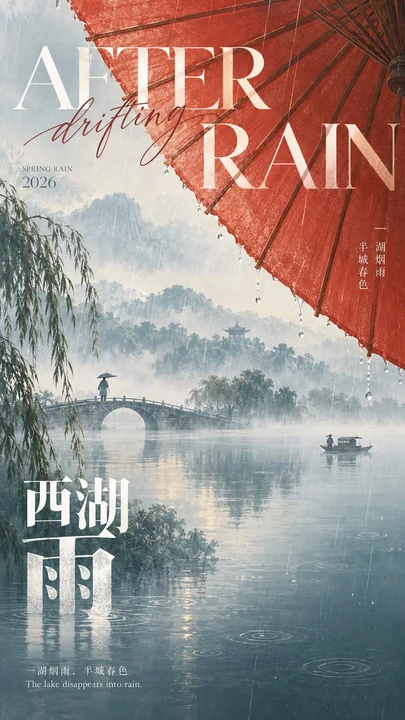
Generate a high-end modern oriental poetic Editorial poster, merging oriental landscape artistic conception, super-scale main visuals, miniature character narratives, and modern Chinese and English Typography into a complete visual work.

Overall, do not make it like a common national-style promotional image, travel poster, or festival template; instead, present a design sophistication akin to a cultural brand Campaign, arts festival visual, or magazine Editorial poster.

Use large areas of soft color gamuts to construct space, with the [Main Color Tone] as the primary environmental color, using only the [Accent Color] to centrally strengthen the [Super-scale Main Visual], making the subject identifiable at a glance even in thumbnail state. The background landscape uses ink wash blooming, pastel diffusion, mist, soft-edged color blocks, etc., to represent it, reducing realistic details; do not let buildings, trees, and peaks become overly eye-catching.

Enlarge the [Super-scale Main Visual] far beyond realistic proportions, and through cropping, blocking, interweaving, or perspective relationships, let it truly enter the screen space rather than simply floating. It is best for the subject to retain only one strongest visual anchor, avoiding multiple large objects competing for attention at the same time.

Add extremely small-scale [Miniature Characters and Actions], utilizing the scale contrast between "huge environment / giant objects" and "miniature characters" to enhance the sense of space, poetry, and storytelling. Characters should not be the protagonists or pose; they serve only as scale references and narrative points.

Use an extra-large English [English Main Title] at the top or upper part, using a slender, high-contrast, modern Editorial Serif font, allowing the text to span the screen, misalign, be cropped, and form real front-and-back occlusion relationships with elements like giant objects, mist, plants, rain lines, water droplets, steam, etc. A slender, natural English script can be added as a flexible visual line, but do not stack too many fonts.

Place the Chinese main title [Chinese Main Title] in the middle-lower or bottom-left area, with the size significantly enlarged, creating partial occlusion, edge-pressing, reflections, or interweaving with the landscape, making the text part of the composition rather than simply overlaid on the image surface. Use [Subtitle] for the subtitle, keeping it concise and real.

Incorporate a "physical relationship" based on the theme to enhance the sense of visual methodology, such as: refraction, reflection, steam turning into clouds, rain ripples, front-and-back occlusion, transparent media, huge proportion differences, objects passing through text, etc. Visual relationships should be understandable at first glance and surprising at the second.

Control overall information density: the top Typography, the middle core main visual, and the bottom Chinese title areas can be denser, while other areas should be proactively left blank. Avoid full-screen small text and decorations.

All text must be real, meaningful, and readable; do not use garbled characters, meaningless English, fake logos, fake brands, serial numbers, or template placeholder information.

画面质感 (Visual texture) should remain high-end, soft, restrained, and modern oriental. Avoid overly strong CGI light effects, cheap glowing, plastic materials, over-sharpening, stacking of traditional patterns, travel promotion feel, e-commerce promotion feel, complex ancient building complexes, full-screen festival elements, or four-pointed star decorations.

The final work needs to simultaneously possess: large color gamut, strong visual anchors, giant objects and tiny people, oriental poetic realm, modern Editorial Typography, real spatial interweaving, obvious design methodology, and a sense of a complete poster work.

【主题】:{填写,例如:西湖雨 / 白露 / 春茶 / 元宵}
【英文主标题】:{填写}
【中文主标题】:{填写}
【副标题】:{填写}
【超尺度主视觉】:{填写,例如:巨型油纸伞 / 露珠 / 茶盏 / 灯笼}
【东方景观】:{填写,例如:湖面 / 山谷 / 茶山 / 江南水岸}
【微型人物与动作】:{填写}
【主色调】:{填写}
【强调色】:{填写}
【季节 / 年份小字】:{可选}
【画幅比例】:{默认 9:16}

生成一张高级现代东方诗意 Editorial 海报,将东方景观意境、超尺度主视觉、微型人物叙事与现代中英文 Typography 融合成完整视觉作品。

整体不要做成普通国风宣传图、旅游海报或节日模板,而要呈现文化品牌 Campaign、艺术节视觉、杂志 Editorial 海报般的设计完成度。

画面使用大面积柔和色域构建空间,以【主色调】作为主要环境颜色,仅使用【强调色】集中强化【超尺度主视觉】,让主体在缩略图状态下一眼可辨识。背景景观使用水墨晕染、粉彩扩散、薄雾、柔边色块等方式表现,减少写实细节,不要让建筑、树木和山峰过度抢眼。

将【超尺度主视觉】放大到远超现实比例,并通过裁切、遮挡、穿插或透视关系让它真正进入画面空间,而不是简单悬浮。主体最好只保留一个最强视觉锚点,避免同时出现多个大物体争夺视线。

加入极小尺度的【微型人物与动作】,利用“巨大环境 / 巨物”和“微型人物”的尺度反差增强空间感、诗意和故事性。人物不要成为主角,不要摆拍,只作为尺度参照和叙事点。

顶部或上半部分使用超大英文【英文主标题】,采用纤细、高对比、现代 Editorial Serif 字体,允许文字跨越画面、错位、裁切,并与巨物、雾气、植物、雨线、水滴、蒸汽等元素形成真实前后遮挡关系。可加入一处纤细自然的英文手写体作为柔性视觉线条,但不要堆叠过多字体。

中文主标题【中文主标题】放在中下部或左下区域,尺寸明显放大,与景观产生局部遮挡、压边、倒影或穿插,使文字成为构图的一部分,而不是简单覆盖在图片表面。副标题使用【副标题】,保持简洁真实。

根据主题加入一种“物理关系”增强视觉方法感,例如:折射、倒影、蒸汽变云、雨水涟漪、前后遮挡、透明介质、巨大比例差、物体穿过文字等。视觉关系应当第一眼能理解,第二眼出现惊喜。

整体控制信息密度:顶部 Typography、中部核心主视觉、下部中文标题三个区域可以较密,其余区域主动留白。避免满屏小字和装饰。

所有文字必须真实、有意义、可读,不使用乱码、无意义英文、假 Logo、假品牌、编号或模板占位信息。

画面质感保持高级、柔和、克制、现代东方。避免过强 CGI 光效、廉价发光、塑料材质、过度锐化、传统纹样堆砌、旅游宣传感、电商促销感、复杂古建筑群、满屏节庆元素、四角星芒装饰。

最终作品需要同时具备:
大色域、强视觉锚点、巨物微人、东方诗境、现代 Editorial Typography、真实空间穿插、明显设计方法和完整海报作品感。