Case 27593
Design de poster artisanal pour l’art minimaliste en perles de fusion
Prompt
**Subject Restoration**
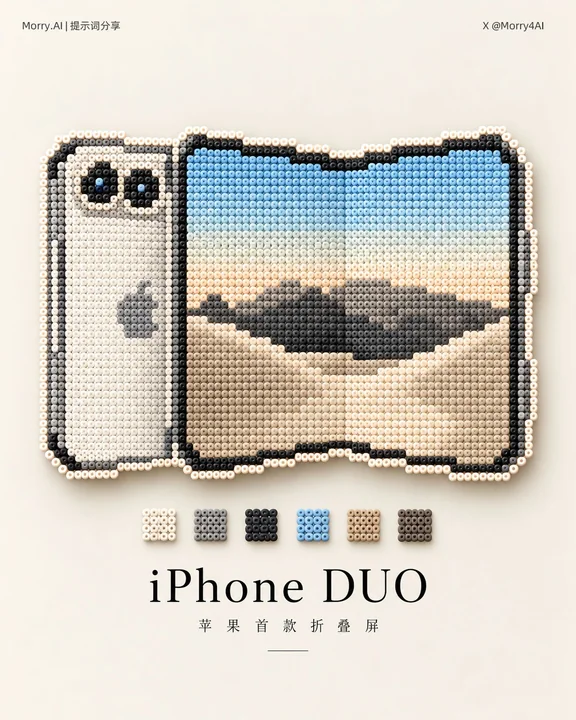
Strictly preserve the outline, proportions, posture, perspective, iconic structure, and main color scheme of the subject in the reference image. Only pixelate and simplify overly detailed structures to ensure the original subject remains recognizable at a glance after conversion. Do not simply apply a pixel filter; instead, completely reconstruct the subject as a real fuse bead piece.

**Fuse Bead Material**
The subject is composed of hundreds of identically sized, regularly arranged cylindrical plastic fuse beads, bead by bead. Each bead must be clearly visible: central round hole, cylindrical structure, regular grid, and subtle gaps between particles. Use a limited color palette to express the subject's structure, shadows, and highlights through different colored fuse beads; use a ring of off-white or white fuse beads around the periphery of the subject to form a complete outline.

**Background and Photography**
The background is replaced with a clean, warm cream-white matte surface. The overall tone is soft and low-saturation, without obvious paper fibers, wood grain, or coarse particles, featuring only an extremely delicate and uniform matte texture. Adopt a real still-life photography texture. Soft natural light shines from the top left, making the fuse beads appear as a delicate matte plastic material, forming a slight, soft floating projection on the cream-white background surface.

**Color Display**
Analyze the reference image and the converted fuse bead subject to extract the 3–5 most representative key colors from the subject, forming a set of minimalist color cards. The color cards are located between the fuse bead subject and the text title, arranged horizontally and centered. Each color block is small in size, uniform in proportion, evenly spaced, and uses solid color blocks without adding gradients, 3D effects, or complex borders. The color card colors must truly come from the subject, including: main colors, auxiliary colors, dark colors, light colors, or recognizable accent colors. Automatically decide to use 3, 4, or 5 color blocks based on the actual color scheme of the subject, without adding meaningless colors just to make up the number. The color card is only an auxiliary visual element; its overall width is significantly smaller than the subject, and it does not grab the visual focus of the subject.

**Typography**
Generate a concise Chinese main title and a very short Chinese subtitle below the color card based on the image content. The Chinese main title uses a modern high-contrast Songti / Mincho style: thin font weight, slender and sharp serifs, stretched character shapes, appropriately increased letter spacing, and centered arrangement. The subtitle font size is significantly smaller and thinner, with wider letter spacing. The overall feel is that of high-end Chinese magazines, art publications, and boutique brand advertisements.

**Composition**
The image adopts a 4:5 vertical minimalist editorial poster layout. Regardless of the original aspect ratio of the reference image, the final image is always re-adapted to a 4:5 vertical format and does not follow the original image's aspect ratio.

**Layout Structure**
Large white space at the top
↓
Fuse bead subject
↓
3–5 theme color blocks
↓
Chinese main title
↓
Small Chinese subtitle
↓
Large white space at the bottom

The fuse bead subject is located in the upper-middle of the frame, occupying about 35%–50% of the frame. Automatically adjust the size of the subject based on its own horizontal, vertical, or irregular outline, showing it completely while maintaining the original proportions, without stretching, compressing, or cropping. All elements are aligned along the central axis, maintaining sufficient spacing and a large amount of negative space. The subject, color cards, title, and subtitle are all located within the safety area, not close to the edges of the frame, and the overall layout is not damaged by the different proportions of the reference image. The final frame size is fixed at 4:5 vertical.

**Overall Style**
Fuse Bead Craft × Pixel Art × Color Palette × Minimal Editorial Poster × Product Photography. The image is restrained, quiet, exquisite, and high-end, like a color research page in an independent design magazine or a boutique brand visual archive.

**Avoid**
Ordinary pixel art, mosaics, Lego, glass beads, cross-stitch, knitting effects, complex backgrounds, huge color blocks, rainbow color schemes, gradient color cards, thick bold fonts, cartoon fonts, calligraphy fonts, complex text effects, and excessive 3D.
Autres prompts
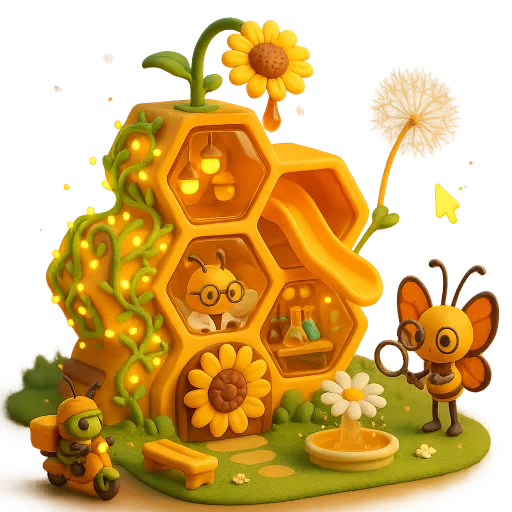
Case 3
Ville scientifique des abeilles
Créer une image en style 3D Q, un mini laboratoire scientifique sucré à structure de ruche, dont l'architecture est composée de cellules hexagonales transparentes en cire d'abeille empilées, avec au sommet un arroseur de tournesol suspendu
naturearchitecture
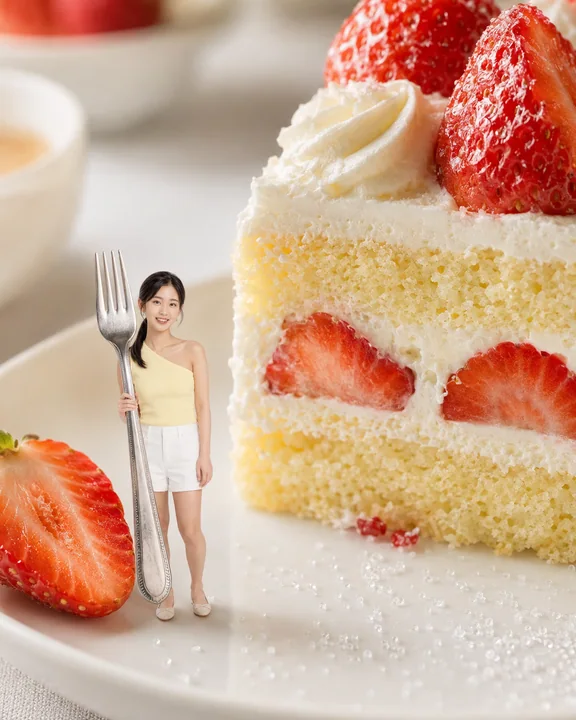
Case 16481
Trois centimètres d’aventure miniature sur un gâteau à la fraise
微缩世界微距摄影甜点景观奇幻创意草莓蛋糕