Case 26816
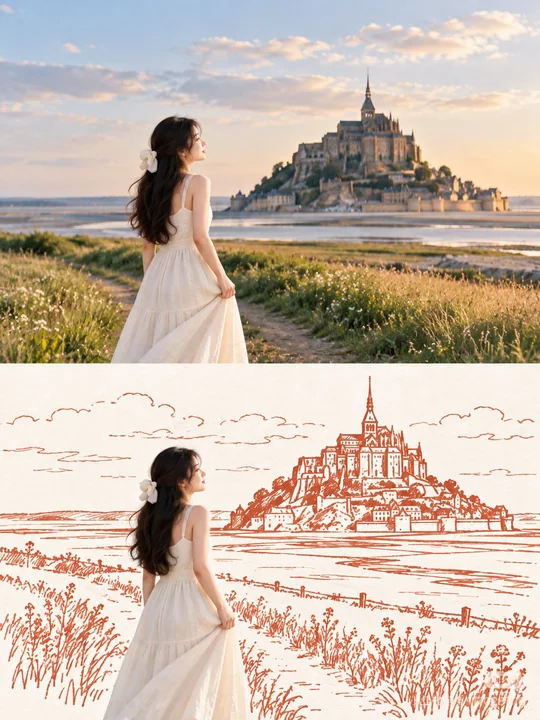
真实人物与单色手绘环境对比海报
Prompt
Please make the photo I uploaded into a 3:4 vertical "Original Photography at the top / Line Art Translation at the bottom" comparison poster.

**[Keep the Subject Realistic]**

The people in the photo always maintain a complete photo-level realistic effect. Facial features, skin tone, hairstyle, hair color, expressions, movements, clothing, accessories, and body proportions are all taken from the original photo—do not redraw, do not change clothes, do not change movements, do not add or subtract people, and do not have missing limbs.

The image continues to use the original photo's framing, cropping range, lens angle, person size, and location—do not mirror, do not re-center, do not scale randomly, and do not create new movements for the person. The person always stays in their original position as the real visual subject of the image. Important objects the person is holding or using can continue to retain the photo texture.

**[Convert Environment into Hand-drawn World]**

In the bottom half, the environment around the person completely breaks away from the photographic texture and shifts to a soft warm-white paper background.

Buildings, trees, mountains, walls, doors/windows, curtains, furniture, books, plants, lamps, carpets, photo frames, and other background objects are all simplified based on the position and proportions of the original photo, redrawn with loose, generalized monochromatic lines.

There is no need to copy all real details; only keep the main outlines, size relationships, and spatial positions that allow the scene to be identified. Remove the original background colors, real shadows, photographic textures, and material expressions.

**[Monochromatic Line Rules]**

The entire environment in the bottom half only allows the use of **one saturated monochromatic ink line**.

Prioritize extracting an obvious non-neutral color from the original photo, then adjust it to a clear, bright, medium-saturation color. If the original image is generally grey, white, or has no obvious primary color, automatically choose an accent color that coordinates with the image, such as cobalt blue, brick red, coral red, forest green, deep cyan, purple, wine red, ochre orange, etc.

One image can only have one line art color; mixing a second color is not allowed.

The line texture should not be like a fine pen drawing, nor like a pencil sketch, but closer to the **casual drawing feel between a medium marker and a ballpoint pen**: lines can shake slightly, thickness and pressure can vary slightly, turns do not have to be perfectly accurate, connections can be slightly misaligned, and line ends are allowed to slightly overshoot, giving an overall natural feel of being drawn in one go.

Outlines should not be too neat; they should retain a bit of clumsiness, imperfection, and spontaneity.

Objects should be summarized with simple shapes as much as possible:

Books are represented by simple rectangles;

Plants are represented by several groups of loose leaves;

Lamps are represented by simple domes and supports;

Windows only keep the basic frame;

Fabric only has a few sparse folds drawn.

Do not strive to fill the whole drawing; retain a large amount of warm-white negative space to make the image relaxed, breathable, and have a bit of an unfinished manuscript feel.

**[Ground and Space Treatment]**

The ground, roads, tabletops, wall corners, countertops, etc., only keep the most basic outer outlines and a few structural seam lines.

Do not use a grey base, do not draw real shadows, do not fill large areas with color, and do not create 3D light and shadow. All environmental elements always use the same ink color, letting the photo-realistic person naturally overlap on top of the monochromatic hand-drawn environment.

**[Overall Visual Direction]**

The final effect should present a clear **"Realistic Subject × Coarse Monochromatic Hand-drawn Environment"** contrast.

Overall temperament leanings:

**Editorial collage, independent magazine lifestyle illustration, simple environmental graffiti, clean warm-white paper, minimalist, interesting, relaxed.**

The bottom half is not a refined illustration, but a generalized monochromatic background manuscript with human traces.

**[Prohibited]**

Do not draw real people as illustrations or cartoons;

Do not change the person's identity, face, clothing, and posture;

Do not add extra people;

Do not have missing hands/feet or limb errors;

Do not add important objects out of thin air that do not exist in the original image;

Do not use multi-color line art;

Do not retain realistic photographic backgrounds;

Do not do gradients, watercolors, 3D, anime, manga, or refined vector illustrations;

Do not add text, logos, watermarks, interface elements, or any UI.

请将我上传的照片制作成一张 3:4 竖版「上方原始摄影 / 下方线稿转译」对照海报**。

**【主体保持真实】**

照片中的人物始终保持完整的照片级写实效果。脸部特征、肤色、发型、发色、神态、动作、服装、饰品以及身体比例全部沿用原图,不重新绘制,不换衣,不改变动作,不增减人物,也不要出现肢体缺失。

画面继续使用原照片的取景方式、裁切范围、镜头角度、人物尺寸与所在位置,不镜像,不重新居中,不随意缩放,也不要为人物创造新的动作。人物始终停留在原本的位置,作为画面的真实视觉主体。人物正在拿着或使用的重要物件可以继续保留照片质感。

**【环境转成手绘世界】**

下半部分中,人物周围的环境全部脱离摄影质感,转换到柔和的暖白纸张背景上。

建筑、树木、山体、墙面、门窗、窗帘、家具、书籍、植物、灯具、地毯、相框以及其他背景物件,都根据原照片的位置与比例进行简化,用松散、概括的单色线条重新画出。

不需要复制所有真实细节,只保留能识别场景的主要轮廓、大小关系和空间位置。去除背景原有的颜色、真实阴影、摄影纹理和材质表现。

**【单色线条规则】**

整个下半部分的环境只允许使用 **一种饱和单色墨线**。

优先从原照片中提取一个明显的非中性色,再将它调整为清晰、明亮的中等饱和色。若原图整体偏灰、偏白或没有明显主色,则自动选择与画面协调的强调色,例如钴蓝、砖红、珊瑚红、森林绿、深青、紫色、酒红、赭橙等。

一张图只能有一种线稿颜色,不允许混用第二种颜色。

线条质感不要像精细钢笔画,也不要像铅笔素描,更接近 **中粗号记号笔与圆珠笔之间的随手画感**:线条可以轻微抖动,粗细和压力略有变化,转折不必完全精准,连接处可以稍微错位,线尾允许轻微越界,整体有一次画成的自然感。

轮廓不要太工整,要保留一点笨拙、不完美和随性。

物体尽量用简单图形概括:

书本用简单矩形表示;

植物用几组松散叶片表示;

灯具用简单圆顶和支杆表示;

窗户只保留基本框架;

布料只画少量稀疏褶皱。

不追求画满,保留大量暖白留白,让画面轻松、透气、有一点未完成的手稿感。

**【地面与空间处理】**

地面、道路、桌面、墙脚、台面等只保留最基本的外轮廓以及少量结构缝线。

不使用灰色底,不画真实投影,不大面积填色,不制造立体明暗。所有环境元素始终使用同一种墨色,让照片级真实人物自然叠加在单色手绘环境之上。

**【整体视觉方向】**

最终效果应呈现明显的 **「真实主体 × 粗粝单色手绘环境」** 反差。

整体气质偏向:

**编辑拼贴、独立杂志生活插画、素朴环境涂鸦、干净暖白纸张、极简、有趣、松弛。**

下半部分不是精致插画,而是经过概括的、带有人手痕迹的单色背景手稿。

**【禁止出现】**

不要把真实人物画成插画或卡通;

不改变人物身份、脸、服装和姿势;

不额外增加人物;

不出现缺手缺脚或肢体错误;

不凭空增加原图不存在的重要物件;

不使用多色线稿;

不保留写实摄影背景;

不做渐变、水彩、3D、动漫、漫画或精致矢量插画;

不添加文字、Logo、水印、界面元素或任何 UI。