Case 26809
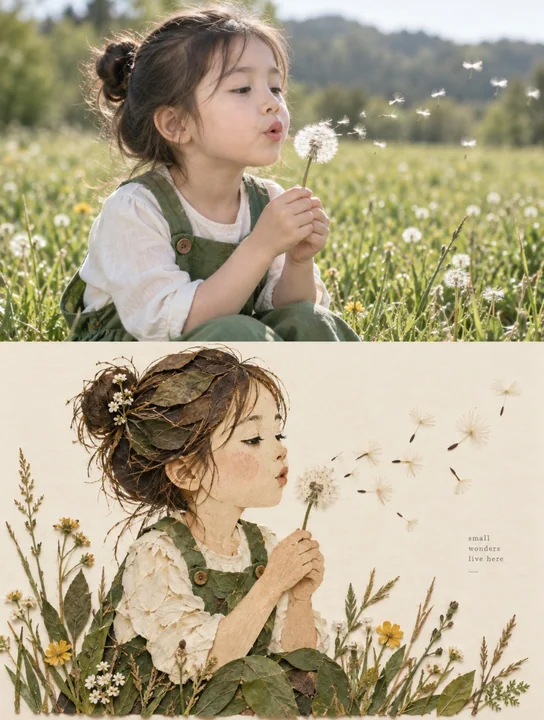
真实照片与自然材料拼贴双拼插画
Prompt
Create a vertical split-screen visual work. The upper part is a real photo uploaded by the user, and the lower part re-translates the figures, pets, animals, or subject relationships from the upper photo into an editorial illustration composed of real natural materials.

The upper and lower images must maintain a clear correspondence in subject identity, outline, posture, and relationship.

Upper Part | User-uploaded original photo
Keep the real photo in the upper part.
Prioritize identifying people, pets, animals, human-animal combinations, and multi-person relationships.
Completely maintain the subject's original identity characteristics, including facial shape, hairstyle, clothing, posture, and movements for people; fur color, patterns, ears, facial shape, body proportions, tail, and movements for pets or animals.
Do not transform the upper part into leaves, petals, or illustrations beforehand.
Allow reasonable cropping according to the vertical layout, but keep the core subject complete and recognizable.
Buildings and complex environments are only kept as the photographic background of the upper part; the lower part does not use buildings as the main translation object.

Lower Part | Natural material collage editorial illustration translation
Extract the most recognizable subject, outline, posture, and narrative relationship from the upper photo, and reconstruct it into an editorial illustration composed of real natural materials.
Use clearly identifiable leaves, petals, branches, fruits, seeds, grass stems, bark, or dry leaves, directly utilizing their original shapes, textures, color differences, and irregular edges to assemble the subject.
Do not cut the plants into overly precise geometric shapes, nor use a complete illustration outline to enclose the plants.
Make the viewer recognize that the bottom represents the same person, animal, or group of interacting subjects as the top photo, while also clearly seeing that it is ingeniously composed of real natural elements.
Natural materials are not decorations outside the person's photo, but truly undertake the subject's body structure.
For example:
A person's hair can be formed by naturally curling or layered leaves, grass stems, or petals;
Clothing can utilize leaves of different sizes and comprehensive color differences to form the main area;
Arms and legs can be represented using branches, grass stems, or elongated leaves according to the original posture;
Pet ears can choose naturally pointed leaves;
Tails can use curved branches or slender plant materials;
Face and body should try to utilize the natural materials' own outlines rather than relying on extensive drawing.

The composition establishes order with a simple rectangular color field or paper area, but do not deliberately draw a complete border.
The subject maintains a natural internal and external relationship with the rectangle, with most of it falling within the color field and a few most directional parts naturally extending beyond the boundary.
A person's extended hand, a pet's tail, ears, branches, or movement directions can naturally exceed the color field, giving the image a relaxed sense of "crossing boundaries"; like plants just happening to grow out of the layout, rather than striking a pose for the sake of "breaking the frame."
Maintain a large amount of white space, a clear center of gravity, and incomplete symmetry, allowing the randomness of natural materials to coexist with the order of editorial design.

Black lines appear only as a minimal auxiliary language and do not serve as the overall outline for the subject.
Can be used for eyes, mouths, minimalist expressions, small movement hints, local connections, short lines, handwriting marks, or slight visual rhythms in the layout.
The lines are thin, relaxed, and slightly hand-drawn, letting the plants themselves undertake the subject's form and outline.
In particular, it is forbidden to use black lines to completely outline a person's body or a pet's outer contour and then fill it with plants.

The color scheme extracts the most vital and recognizable color temperament from the original image in the upper part, and then re-translates it through the colors of natural plants themselves.
For example, if the person above wears green, orange, or blue clothing, the bottom can look for real materials like leaves, petals, or fruits with similar comprehensive colors for correspondence.
A pet's orange, gray, black and white patterns, etc., can also be cleverly reproduced using the comprehensive color differences of natural materials, but the plants cannot be artificially dyed into completely uniform color blocks to match the colors.
Retain the real comprehensive color differences of leaves, petals, fruits, and dead branches, without excessive uniform dyeing.
The background uses light or soft comprehensive colors coordinated with the original image, making the natural materials the visual center of the image, overall fresh, restrained, vital, and not cluttered.

Text remains minimal and acts as a lightweight element in the editorial design.
Extract a short English title and a few micro-annotations from the photo's mood, action, relationship, or metaphor, which can be placed close to the edge of the rectangular color field, suspended in the white space, or cleverly aligned with a branch or leaf direction.
Don't overshadow the subject, and don't make it like a regular poster title.
If the photo's emotion is very clear, the text can express its hidden relationship; if not necessary, text can be further reduced.

The overall presentation is a visual relationship of real natural materials x slight black hand-drawn marks x geometric color field x natural boundary crossing, maintaining a sense of handmade, clever, relaxed, poetic, and high-end editorial feel.
The bottom is not an ordinary "leaf portrait sticker," but should be as if an art director carefully selected different natural materials to cleverly reconstruct the person or pet from the upper photo with natural outlines.
Avoid complete black outlines, plants cut into regular color blocks, children's leaf collages, deliberate boundary crossing, cartoon collages, and templated compositions.
Forbidden to recreate people or animals unrelated to the identity above.
Forbidden for complex buildings to become the main objects of natural material collage.

创作一张竖版上下双拼视觉作品,上半部分为用户上传的真实照片,下半部分将上方照片中的人物、宠物、动物或主体关系重新转译成由真实自然材料拼合而成的编辑插画。

上下画面必须保持主体身份、轮廓、姿态以及关系上的明显对应。

上半部分|用户上传原图

上半部分保留真实照片。

优先识别人物、宠物、动物、人与动物组合以及多人关系。

完整保持主体原本的身份特征,包括人物脸型、发型、服饰、姿势和动作;宠物或动物的毛色、花纹、耳朵、脸型、身体比例、尾巴与动作。

不得把上半部分提前转化成树叶、花瓣或插画。

允许按照上下版式进行合理裁切,但保持核心主体完整可辨认。

建筑和复杂环境只保留为上半部分摄影背景,下半部分不以建筑作为主要转译对象。

下半部分|自然材料拼贴编辑插画转译

从上半部分照片中提取最具识别性的主体、轮廓、姿态与叙事关系,重构为由真实自然材料拼合而成的编辑插画。

使用清晰可辨的叶片、花瓣、枝条、果实、种子、草茎、树皮或枯叶,直接利用它们原本的形状、纹理、色差和不规则边缘组合主体。

不要把植物切割成过于精准的几何形,也不要用完整插画轮廓包住植物。

让观看者既能认出下方表现的是上方照片中的同一个人物、同一只动物或同一组互动主体,也能清楚看见它是由真实自然元素巧妙拼合而成。

自然材料不是装饰在人物照片外面,而是真正承担主体身体结构。

例如:

人物头发可以由自然卷曲或层叠的叶片、草茎、花瓣形成;

服装可以利用不同尺寸和综合色差的叶片形成主要面积;

手臂和腿部可以根据原姿态利用枝条、草茎或狭长叶片表现;

宠物耳朵可以选择天然尖形叶片;

尾巴可以使用弯曲枝条或细长植物材料;

脸部与身体应尽量利用天然材料自身轮廓形成,而不是依赖大量绘制。

构图以一个简洁的矩形色域或纸面区域建立秩序,但不要刻意画出完整边框。

主体与矩形保持自然的内外关系,大部分落在色域之中,少量最具方向感的部分自然伸出边界。

人物伸出的手、宠物尾巴、耳朵、枝条或动作方向可以自然超出色域,使画面产生轻松的越界感;像植物恰好从版面中生长出来,而不是为了“突破边框”刻意摆造型。

保持大面积留白、明确重心和不完全对称,让自然材料的偶然性与编辑设计的秩序并存。

黑色线条只作为极少量辅助语言出现,不为主体整体描边。

可用于眼睛、嘴巴、极简表情、细小动作暗示、局部连接、短线、手写痕迹或版式中的轻微视觉节奏。

线条纤细、松弛、略带手绘感,让植物本身承担主体的形体与轮廓。

尤其禁止用黑线完整勾勒人物身体或宠物外轮廓,再在里面填植物。

配色从上半部分原图中提取最有生命力和辨识度的色彩气质,再通过天然植物自身的颜色重新转译。

例如上方人物穿绿色、橙色、蓝色服装时,下方可以寻找具有相近综合色彩的真实叶片、花瓣、果实等材料对应。

宠物的橘色、灰色、黑白花纹等也可以利用天然材料综合色差巧妙重现,但不能为了匹配颜色而把全部植物人工染成完全统一的色块。

保留叶片、花瓣、果实和枯枝真实的综合色差异,不过度统一染色。

背景使用与原图协调的浅色或柔和综合色,使天然材质成为画面的视觉中心,整体清新、克制、有生命力而不杂乱。

文字保持极少,并作为编辑设计中的轻量元素。

从照片的情绪、动作、关系或隐喻中提炼一个简短英文标题和少量微型注释,可贴近矩形色域边缘、悬置于留白中,或与一根枝条、叶片方向形成巧妙对齐。

不要抢主体,也不要做成常规海报标题。

如果照片情绪非常明确,可以让文字表现其隐藏关系;如果没有必要,可以进一步减少文字。

整体呈现真实自然材料 × 轻微黑色手绘痕迹 × 几何色域 × 自然越界的视觉关系,保持手工、聪明、松弛、诗意和高级编辑感。

下方不是普通“树叶贴人像”,而应该像艺术指导精心挑选不同自然材料,用天然轮廓巧妙重新构建了上方照片中的人物或宠物。

避免完整黑色描边、植物被切成规则色块、儿童树叶贴画、刻意越界、卡通拼贴和模板化构图。

禁止重新创造与上方身份无关的人物或动物。

禁止复杂建筑成为自然材料拼贴的主要对象。
Autres prompts
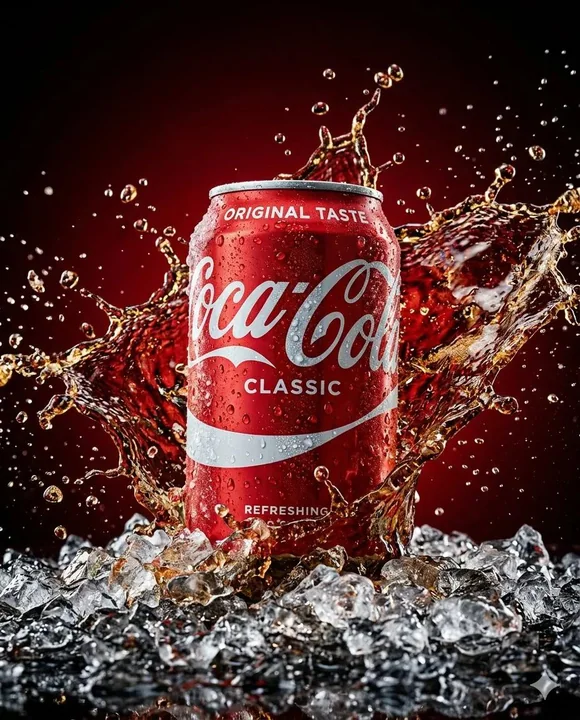
Case 12241
Effet visuel d’éclaboussures de gouttes d’eau sur une canette de Coca-Cola glacée
Une canette de Coca-Cola bien fraîche recouverte de gouttelettes d’eau glacée, entourée de glace pilée et d’éclaboussures spectaculaires de cola, sur un fond dégradé rouge foncé, publicité rafraîchissante pour boisson énergisante, éclairage

Case 12234
Affiche infographique de style magazine rétro de Sadie Sink
Créez une infographie visuellement riche sur [Sadie Sink]. Faites des recherches sur son époque, ses réalisations clés, ses tournants décisifs et son impact durable. Utilisez une illustration centrale dramatique en style portrait comme poin