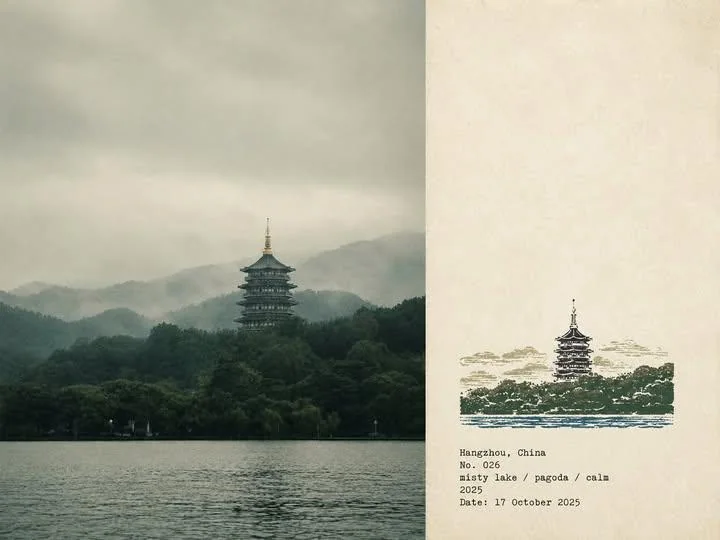
Please create a separate "Rubber Stamp Travel Field Notes Poster" for each photo I upload, outputting each photo individually without collage or multi-image combinations. Overall, use a 4:3 landscape composition, dividing the frame into left and right regions, but without drawing an obvious dividing line. The left side takes up about 58% of the frame, faithfully preserving the original photo. Accurately maintain the main subject identity, terrain, architecture, plants, people, spatial relationships, natural lighting and shadows, authentic textures, and the original color atmosphere; apply only restrained art publication-level photo color grading, and add extremely subtle, fine-grained film noise. For layout adaptation, natural cropping is allowed, but do not stretch, distort, shift, replace, or redraw the main subject. The right side takes up about 42% of the frame, using a warm off-white aged paper as the background. The paper features subtle fibers, natural grain, light usage marks, and a matte texture, while preserving large areas of unprinted paper whitespace, making the blank space an essential part of the layout. Analyze the original photo and extract the most location-distinctive subject outlines, architectural structures, terrain contours, plant forms, roads, shorelines, or other key visual relationships, compressing them into a small multi-color rubber stamp image. Do not replicate every single element from the photo item by item. Retain only the minimal information necessary to instantly recognize the original location, subject, and scene relationships. Remove crowds, vehicles, dense windows, repetitive buildings, fragmented vegetation, decorative elements, and irrelevant backgrounds. The stamp is positioned in the lower-middle of the right-side paper area, occupying only about 30%–38% of the right region's height, with ample whitespace preserved around it. The stamp must not be enlarged into a standard illustration, full landscape painting, or brand logo. Determine the stamp's organization based on the original photo's composition: * Iconic architecture: Retain the most distinctive outer contours, roofs, domes, arches, towers, or main structures. * Mountain settlements: Compress buildings into a few terraced color blocks aligned along the terrain. * Coastal scenery: Retain mountain contours, settlement layers, shorelines, and sparse intermittent water ripples. * City panoramas: Retain the main skyline, one iconic building, and one or two layers of distant mountains. * Natural landscapes: Retain primary mountain forms, trees, shorelines, or road orientations. * Foreground occlusions: If narratively important in the original photo, retain as foreground stamp outlines. Extract 2–4 spot inks from the original photo. Prioritize desaturated colors like carbon black, deep green, brick red, ochre yellow, slate blue, or taupe brown, but do not force a fixed palette. Preserve the most distinctive color character from the original photo, allowing only a small area of color for visual emphasis. Render each color as a separately hand-stamped effect: Authentic rubber stamp carving texture, hand-engraved marks, uneven line widths, contour notches, fractured edges, dry ink shortages, paper show-through, granular ink, uneven pressure, partial ghosting, and about 1–2 mm of subtle misregistration. Allow natural misalignment between color layers; edges must not be digitally smoothed. The print should resemble a real carved stamp pressed onto aged paper, not a filtered photo, smooth vector illustration, or line-art logo. Generate text based on the photo's location, theme, and visual imagery: Location English name No. Number Three short English keywords Gregorian calendar year Place the text below or adjacent to the stamp in the whitespace, using a small, restrained, slightly mechanically imperfect typewriter font. The typography should evoke a traveler's field record, not an ad headline. Ensure all text is spelled accurately, without adding irrelevant slogans, brands, or decorative copy. The overall vibe is like field notes kept by an architect, travel writer, or natural observer: quiet, restrained, tactilely real, regionally specific, with handmade imperfections and a collectible feel. The photo handles the on-site record; the stamp captures the most recognizable fragments of memory. The date should display the date I enter: [여기에 날짜를 입력해주세요] Avoid: Obvious central dividing lines, circular seals, Chinese red stamps, postage stamp perforations, wax seals, sticker collages, tourist souvenir templates, smooth vector logos, generic city icons, full replication of all architecture, dense detailing, childlike craftiness, cartoon style, 3D rendering, plastic textures, glossy digital gradients, oversaturation, excessive text, decorative clutter, and redrawing or altering the left-side original photo. 请为我上传的每张照片分别创建一份“橡皮印章旅行实录海报”,每张照片单独输出,不进行拼贴或多图组合。 整体采用 4:3 横向构图,将画面分为左右区域,但不绘制明显的分割线。 左侧约占构图的 58%,忠实地保留原始照片。准确维持主体身份、地形、建筑、植物、人物、空间关系、自然光影、真实纹理以及原始色彩氛围;仅应用克制的艺术出版级照片调色,并添加极其细微的细颗粒电影胶片噪点。为了适配布局,允许自然裁剪,但不得拉伸、扭曲、偏移、替换或重绘主体。 右侧约占构图的 42%,使用温暖的米白色陈旧纸张作为背景。纸张具有细微的纤维、自然纹理、轻微的使用痕迹和哑光质感,同时保留大面积未打印的纸张留白,使留白成为布局中不可或缺的一部分。 分析原始照片并提取最具地理特征的主体轮廓、建筑结构、地形轮廓、植物形态、道路、海岸线或其他关键视觉关系,将它们压缩成一个小型的多色橡皮印章图像。 不要逐一复制照片中的每个元素。仅保留即刻识别原始位置、主体和场景关系所需的最低限度信息。去除人群、车辆、密集的窗户、重复的建筑物、碎片化的植被、装饰性元素和不相关的背景。 印章位于右侧纸张区域的中下方,仅占右侧区域高度的约 30%–38%,周围保留充足的留白。印章不得放大成标准的插图、完整的风景画或品牌标志。 根据原始照片的构图决定印章的组织方式: * 标志性建筑:保留最独特的外部轮廓、屋顶、穹顶、拱门、塔楼或主要结构。 * 山地聚落:将建筑物压缩为沿地形排列的几个阶梯状色块。 * 海岸风光:保留山脉轮廓、聚落层次、海岸线和稀疏断续的水面波纹。 * 城市全景:保留主要天际线、一座标志性建筑以及一两层远山。 * 自然景观:保留主要的山形、树木、海岸线或道路方向。 * 前景遮挡:如果原始照片中具有叙事重要性,则保留为前景印章轮廓。 从原始照片中提取 2–4 种专色墨水。优先考虑低饱和度颜色,如碳黑、深绿、砖红、赭黄、石板蓝或灰褐色,但不强求固定色板。保留原始照片中最具特色的色彩特征,仅允许小面积色彩进行视觉强调。 将每种颜色渲染为单独的手盖印效果: 真实的橡皮章雕刻纹理、手刻痕迹、线条粗细不均、轮廓缺口、断裂边缘、干墨缺墨、透纸感、颗粒感墨迹、压力不均、部分重影,以及约 1-2 毫米的细微套印不准。 允许颜色层之间产生自然的对位偏差;边缘不得进行数字平滑处理。印迹应看起来像压在旧纸上的真实手工雕刻印章,而不是滤镜照片、平滑的矢量插图或线条艺术标志。 根据照片的地点、主题和视觉意象生成文本: 地点英文名称 编号数字 三个简短的英文关键词 公历年份 将文本放置在留白区域中印章的下方或相邻位置,使用细小、克制、略带机械缺陷的打字机字体。排版应唤起旅行者实地记录的感觉,而不是广告标题。确保所有文本拼写准确,不添加无关的口号、品牌或装饰性文案。 整体氛围就像建筑师、旅行作家或自然观察者记录的实地笔记:安静、克制、触感真实、具有地域特色,带有手工瑕疵感和收藏感。照片负责现场记录;印章捕捉最易辨识的记忆片段。 日期应显示我输入的日期:[여기에 날짜를 입력해주세요] 避免:明显的中央分割线、圆形印章、中式红章、邮票齿孔、火漆印章、贴纸拼贴、旅游纪念品模板、平滑的矢量标志、通用的城市图标、建筑全貌复制、密集的细节描述、幼稚的手作感、卡通风格、3D 渲染、塑料质感、光滑的数字渐变、过度饱和、过多的文字、装饰性杂乱,以及重绘或改动左侧原始照片。

为 [CHARACTER] 创建一幅风格化的卡通插图,其身体呈平滑的垂直药丸状(上下呈圆形,左右对称)。身体应为单一、统一的胶囊形状,没有四肢。不要改变角色的核心设计或个性,而是将其简化为这种俏皮的胶囊形状。使用粗黑色轮廓、扁平矢量风格的配色和简单的几何特征。赋予角色大而富有表现力的眼睛和有趣、夸张的面部表情,以反映其原始个性。如果角色穿着衣服,请包含其服装的极简标志性版本。如果没有,请保持身体干净,不穿衣服。使用纯亮黄色背景。将角色置于方形框架的中心。仅使用扁平颜色。不要使

Please turn each travel photo I upload into an independent "Stitch Travel Memory" editorial poster, outputting each photo separately without any multi-image stitching. This style is suitable for photos of 1–3 people with complete silhouette

一幅刺绣肖像,以[颜色]线在深色亚麻布上缝制。可见的针脚、层次分明的纹理和手工图案赋予其一种质朴而神圣的感觉。 一幅埃隆·马斯克的刺绣肖像,用丰富的钢灰色和电光蓝色线在深色亚麻布上缝制。可见的针脚、层次分明的纹理和手工图案赋予其一种质朴而神圣的感觉。