Case 25090
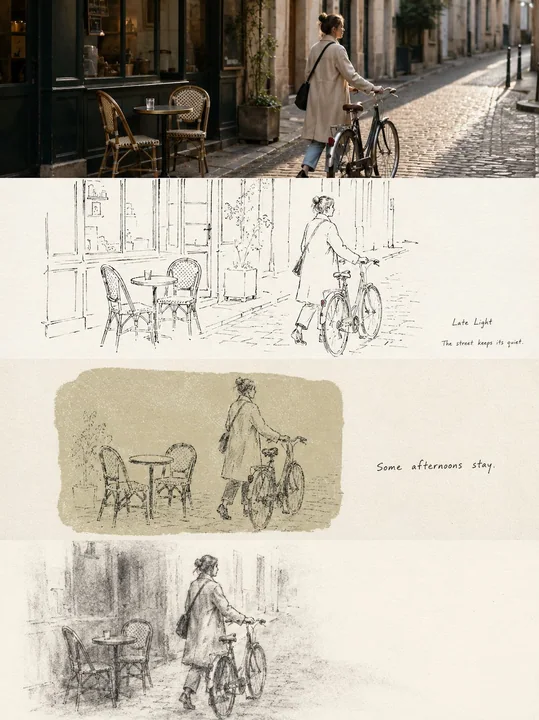
单图四层多媒介艺术海报
Prompt
Please create a high-end design poster of the same scene from the uploaded photo in the current layer, no multi-photo stitching, each photo output individually. Here, 'no multi-photo stitching' means: do not mix different uploaded photos into the same finished product; each uploaded photo must independently generate a complete four-layer style poster.

【Overall Aspect Ratio and Four-Layer Structure】
The overall layout adopts a 3:4 vertical composition. The image is strictly divided into four equal horizontal areas from top to bottom, with each area's height accurately accounting for 25% of the total image height; the ratio of the four layers is strictly 1:1:1:1, no ratio deviations allowed. Seamless connection between the four layers, no dividing lines, no white gaps, no borders.

Since each layer is actually an extremely flat banner of approximately 3:1, the subject needs to be horizontally adapted within each layer: maintain the stability of the subject's main position and visual focus, prioritize horizontal expansion, and avoid the subject being vertically stretched, squashed, touching edges, or having key parts cropped. Environment white space such as sky, wall, ground, water surface, paper, or environment consistent with the original image can be extended to the left and right, but blurred duplicated background filling must not be used.

【Consistency Across Four Layers】
The four layers must come from the same uploaded photo and the same moment. Strictly maintain the consistency of subject identity, number of subjects, human or animal facial features, posture, action direction, line of sight, hairstyle, core clothing characteristics, architectural structure, landmark identity, major object relationships, observation angle, perspective direction, left-right positioning, front-back hierarchy, and narrative relationships. Style layers are allowed to delete secondary backgrounds, reduce textures, and change materials and detail density according to their respective media, but the subject cannot be replaced with another person, another building, another car, another animal, or another scene.

【Layer 1 | Original Photography】
The first layer faithfully preserves the true photographic texture of the uploaded photo. Retain subject identity, quantity, compositional relationships, posture, action, real materials, natural lighting, comprehensive color temperature, and scene atmosphere. Only restrained high-end photography-grade color grading, exposure, and contrast fine-tuning, as well as extremely slight fine-grain optimization, are allowed. To adapt to the current approximately 3:1 banner, natural cropping or extension of environment edges consistent with the original scene is allowed, but stretching, distortion, mirroring, duplicating subjects, moving key objects, changing architectural structures, or redesigning characters is not allowed. The first layer does not add extra text, brand logos, borders, watermarks, or decorative elements.

【Layer 2 | Travel Daily Black and White Line Drawing Observation Poster | Current Layer Adaptation Rules】
This layer only occupies 25% of the height of the overall 3:4 four-panel poster, which is actually an extremely flat horizontal area of approximately 3:1. All style descriptions below are executed "within the current layer." Any expressions in the source prompt such as independent poster, entire image, vertical ratio, separate output, etc., must not change the four-panel overall structure; the current layer's approximately 3:1 flat horizontal ratio is the highest priority. No original image comparison area, second photo, upper/lower split screen, or extra multi-grid may be generated inside the current layer. If there are recomposition requirements in the source prompt, only refinement of background information, materials, white space, and secondary elements is allowed; the subject identity, quantity, key posture, action direction, observation perspective, main perspective, left-right position, and core spatial relationship must not be changed. If text is an important part of the source style, retain it, but it must be reduced to the minimum necessary quantity clearly readable in the current layer; if the source prompt explicitly requires no text, keep it without text.

【Source Style Full Translation Instructions】
Please create a minimalist black and white daily line drawing observation poster of the same scene from the uploaded photo in the current layer. The overall composition uses the current layer's approximately 3:1 flat horizontal banner, presenting only the line drawing observation image. On warm natural white or soft off-white uncoated paper, re-observe the same scene as a minimalist black and white daily line drawing. Do not automatically trace the original uploaded photo, and do not use the full framing for proportional redrawing. First, determine the relationships that truly carry the story in the photo, such as: two to four people talking, sitting together, walking, or waiting; people staying in a cafe, market, station, or street corner; people looking at maps, buying things, riding a bus, or cycling; the real interaction between people and coffee tables, folding chairs, motorcycles, cars, stalls, steps, benches, pets, or luggage. Keep only the minimum visual information needed to maintain this moment. Prioritize accurate retention of: number of people and mutual positions; postures of standing, sitting, walking, or riding; body orientation, line of sight, and interaction direction; arm movements, leg weight centers, and body tilts; contact relationships between people and tables, chairs, vehicles, pets, and other props; large outlines of hairstyles, hats, clothing, and personal belongings; one to three environment structures that explain the location. Adopt a "reduction and refinement" secondary composition. Shrink the main character or the small group of characters and key props to approximately 45%–70% of the image width, placed in the center or following the spatial direction of the original photo towards one side. Retain approximately 45%–65% of undrawn paper white space around the subject. Use only a small number of longer, lighter, more intermittent structural lines to convey location and direction for the environment, such as: a curb or road perspective line; a small section of wall or architectural outline; a door frame or window; a street lamp; a few tree trunks; an awning; a small section of steps; a table or a few necessary chairs. Background lines actively decrease, break, and stop in the distance; do not build a complete, closed background wall. Delete duplicate window panes, brick joints, signboard text, dense passersby, leaves, photographic shadows, and irrelevant clutter, but do not delete table tops, seats, vehicles, leashes, or other key props that make the character's actions valid. The redrawing area strictly uses only natural paper white and single black or extremely deep charcoal black fine lines. Lines should be: generally thin and approximately uniform; with slight hand tremors and hesitation; local folds and line connection misalignments; some outlines not completely closed; like a painter quickly and accurately recording character relationships on site; retaining a slight sense of clumsiness produced by real hand-drawing. Characters are identified through large outlines of heads, torsos, limbs, hairstyles, hats, and clothing. Face retains only one to three necessary dots/lines; do not depict realistic features, wrinkles, skin texture, or hair strands. Contact between hands and props, leg weight, body tilt, sitting posture, and gait must be accurate so that actions can be clearly understood even without shadows. Local proportions are allowed to appear slightly naive, such as slightly larger hands/feet, slightly shorter bodies, or slightly flatter vehicles, but the subject identity, quantity, posture, action meaning, and scene relationship must not be changed. No coloring. No gray filling, hatching, cross-hatching, stippling, screentone, washing, pencil shading, charcoal rubbing, shadow blocks, or solid black silhouettes. Avoid automatic photo tracing, clean vector outlines, adult coloring books, children's cartoons, comic storyboards, stick figures, continuous line portraits, fashion sketches, realistic pen sketches, technical drawings, architectural blueprints, and full-page backgrounds. Based on the location, people, actions, or daily relationships in the photo, refine a group of very restrained English marginal notes: The first line is a small title of 1–3 English words. The second line is a very short observation sentence of 5–10 English words. Text must be determined word for word in the prompt first; do not let the model improvise. Content should be like a soft record of this moment, such as the state of walking, waiting, talking, sitting together, passing by, or going home; do not write vague travel slogans, and do not fabricate locations, dates, or coordinates. Place text on the continuous paper white edges away from characters and key props. Use a single deep charcoal black, thin, plain, slightly hand-written hesitant, and slightly irregular font, as if written with the same fine ink pen used for the character line drawing. The title is only slightly larger than the observation sentence, overall low-key, and cannot become the primary visual focus. Text area does not exceed 3%–5% of the redrawing area. Bold large characters, color block titles, author names, signatures, accounts, brands, brand logos, watermarks, QR codes, URLs, fake Chinese, and garbled code are prohibited. The overall should be like a mature city observation picture book or travel life shorthand: plain, relaxed, quiet, natural, with a slight sense of humor and inadvertent tenderness. It is not a complete street scene illustration, but uses a small amount of lines to preserve the character relationships that actually happened during the trip. Most important rule: Draw accurately the moment when people interact with people or people interact with objects during the trip. Lines can be clumsy, but information must be clear. Paper white must be more than the depiction.

【Layer 3 | Mixed Media Crayon Memory Card | Current Layer Adaptation Rules】
This layer only occupies 25% of the height of the overall 3:4 four-panel poster, which is actually an extremely flat horizontal area of approximately 3:1. All style descriptions below are executed "within the current layer." Any expressions in the source prompt such as independent poster, entire image, vertical ratio, separate output, etc., must not change the four-panel overall structure; the current layer's approximately 3:1 flat horizontal ratio is the highest priority. No original image comparison area, second photo, upper/lower split screen, or extra multi-grid may be generated inside the current layer. If there are recomposition requirements in the source prompt, only refinement of background information, materials, white space, and secondary elements is allowed; the subject identity, quantity, key posture, action direction, observation perspective, main perspective, left-right position, and core spatial relationship must not be changed. If text is an important part of the source style, retain it, but it must be reduced to the minimum necessary quantity clearly readable in the current layer; if the source prompt explicitly requires no text, keep it without text.

【Source Style Full Translation Instructions】
Please transform the uploaded photo into a mixed media memory card in the current layer. Use textured off-white handmade paper as the background, and add a low-saturation, irregular color block based on the overall tone of the photo. Observe the main subjects in the photo, retain their identity, quantity, outline, posture, direction, and key relationships, and redraw them as a concise dark crayon sketch. Lines are loose, imperfect, with natural breaks, slight hesitation, and manual errors, keeping only the minimum details required to maintain subject recognition. Add a short, clear handwritten English phrase in the white space, and add subtle risograph printing grain. The overall creates a quiet, nostalgic Morandi-style aesthetic, retaining sufficient negative space. Do not add extra elements not present in the photo, and do not mechanically copy the full composition of the original photo.

【Layer 4 | Fading Charcoal Travel Memory Sketch Poster | Current Layer Adaptation Rules】
This layer only occupies 25% of the height of the overall 3:4 four-panel poster, which is actually an extremely flat horizontal area of approximately 3:1. All style descriptions below are executed "within the current layer." Any expressions in the source prompt such as independent poster, entire image, vertical ratio, separate output, etc., must not change the four-panel overall structure; the current layer's approximately 3:1 flat horizontal ratio is the highest priority. No original image comparison area, second photo, upper/lower split screen, or extra multi-grid may be generated inside the current layer. If there are recomposition requirements in the source prompt, only refinement of background information, materials, white space, and secondary elements is allowed; the subject identity, quantity, key posture, action direction, observation perspective, main perspective, left-right position, and core spatial relationship must not be changed. If text is an important part of the source style, retain it, but it must be reduced to the minimum necessary quantity clearly readable in the current layer; if the source prompt explicitly requires no text, keep it without text.

【Source Style Full Translation Instructions】
Please use each travel photo I upload as the only visual basis to create an independent 3:4 vertical fading charcoal travel memory sketch poster respectively. Only present the charcoal memory sketch, do not set up an additional original photo comparison area within the current layer. First study the uploaded photo, identify one or a few visual elements that best carry the travel memory, such as houses, cable cars, people, animals, vehicles, ships, bridges, trees, steps, rock formations, doorways, architectural features, or other clearly identifiable objects. Do not transform the entire photo into a complete charcoal landscape. Only refine the most memorable subjects into loose, isolated charcoal studies on warm white paper, and retain minimal environmental information sufficient to maintain subject identity, scale, direction, and sense of place. The subject usually only occupies 18% to 35% of the paper, leaving a large amount of undrawn paper around it. The environment must be minimalist, not building a complete background. Add at most 1 to 3 quiet clues, such as broken ground lines, a small piece of rock or hillside, two or three strokes of a mountain, a cable car line, a small amount of tree traces, small shadow prompts, or a few groups of short spatial scratches; all other information disappears into the paper white. 【Charcoal Painting Language】 The sketch should be like a real hand-drawn and yet unfinished travel sketch, not like a digital filter. Restrainedly combine willow charcoal, compressed charcoal, charcoal pencils, very light graphite, broad directional strokes, short broken strokes, gray smudged by fingers, kneaded eraser highlights, charcoal powder, loose debris, clear paper tooth, uneven hand pressure, broken outlines, and dry powder residue. Use broad and short directional strokes to describe subject weight and structure, avoiding dense academic-style hatching and excessively fine pencil rendering. Deepest charcoal black is only used for the most critical identification structures, such as doorways, deep shadows, windows, tires, character silhouettes, animal horns, structural joints, cable car supports, ship bottoms, or other necessary anchor points. Use only one or two restrained blurred gray blocks to imply volume, letting the paper continue to show through between lines and gray surfaces. 【Fading Effect】 The sense of disappearance must be like real charcoal being partially erased, digital transparency cannot be used. The visual process is sequentially: clear charcoal structure → broken outline → loose scratches → scattered charcoal powder → undrawn paper. Edges gradually lose definition, as if the painter stopped painting, wiped away the charcoal, lifted traces with an eraser, or intentionally kept unfinished parts. Prohibit digital transparency, blur, glow, mist, airbrush, feathered masks, soft focus, artificial gradients, and digital air fading. The subject should emerge from memory and quietly return to the paper. 【Paper and Color】 The entire image strictly maintains monochrome, using only warm white paper, warm gray, cool gray, charcoal black, and a tiny amount of graphite silver-gray, without bringing in photo colors. The paper should be tangibly real: matte warm white drawing paper with clear paper tooth, subtle fibers, charcoal friction, powder residue, eraser marks, and natural imperfections. 【Composition and Mood】 The finished product is like a page preserved in a high-end travel observation book or museum sketchbook. Charcoal drawing represents the part left in memory during the trip. The overall remains quiet, restrained, broad, tactilely real, imperfect, lonely, with a sense of editing, archives, and subtle emotion. Do not make the charcoal subject too large, and do not fill the paper. Let white space become an important part of the composition. 【Strictly Avoid】 Prohibit collages, multi-photo compositions, complete charcoal landscapes, full-background charcoal paintings, photo black and white filters, photo-level pencil redrawing, dense hatching, academic illustrations, watercolors, ink washes, oil painting effects, digital airbrushing, mist disappearance, artificial blurring, smooth gradient fading, decorative borders, rigid templates, oversized subjects, irrelevant objects, fictional landscapes, changing people or animals, changing buildings, replacing subjects, brand logos, watermarks, explanatory text, numbering, and descriptive text. Final priority: Charcoal translation must maintain the same key subjects, identity, posture, proportion, and visual memory as the uploaded photo, and must not fabricate another scene.

【Final Uniform Check】
1. The height of the four layers must strictly be 25% each, and the order must not be changed.
2. No borders, dividing lines, white space gaps, or card-style spacing allowed between the four layers.
3. The first layer maintains real photography; layers two to four strictly execute their respective source styles without mixing media with each other.
4. Subject identity, quantity, posture, action direction, perspective, key perspective, left-right position, and core spatial relationship must be continuous and consistent.
5. Do not mix different uploaded photos into the same poster.
6. Do not add subjects, landmarks, people, transportation, or key narrative objects that do not exist in the photo because of stylization.
7. Unless a source style explicitly requires text, do not add extra text; all text must be spelled correctly and clearly readable, prohibiting garbled code, pseudo-text, brand logos, QR codes, and watermarks.
8. Each layer must be able to independently display its media characteristics, but after combining the four layers, it should still feel like the same scene gradually translated from reality into different artistic media.

请在当前层将上传照片中的同一场景制作成高级设计海报,不多图拼接,每张照片单独输出。
这里的“不多图拼接”是指:不要把不同上传照片混在同一张成品里;每一张上传照片都必须单独生成一张完整的四层风格海报。

【整体画幅与四层结构】
整体采用3:4竖版构图。画面从上到下严格四等分为四个横向区域,每个区域的高度必须精确占整体画面高度的25%,四层比例严格为1:1:1:1,不允许出现比例偏差。四层之间无缝衔接,不设置分隔线,不留白色缝隙,不使用边框。

由于每层实际约为3:1的极扁横幅,主体需要在每层内部进行横向适配:保持主体主要位置与视觉重心稳定,优先横向展开,避免主体被纵向拉伸、压扁、贴边或裁掉关键部位。可在左右延展与原图一致的天空、墙面、地面、水面、纸张或环境留白,但不得使用模糊复制背景填充。

【四层共同一致性】
四层必须来自同一张上传照片、同一个瞬间。严格保持主体身份、主体数量、人物或动物面貌、姿态、动作方向、视线、发型、服装核心特征、建筑结构、地标身份、主要物体关系、观察角度、透视方向、左右位置、前后层级及叙事关系一致。
风格层允许根据各自媒介删除次要背景、减少纹理、改变材质和细节密度,但不能把主体替换成另一个人物、另一座建筑、另一辆车、另一只动物或另一个场景。

【第一层|原始摄影】
第一层忠实保留上传照片的真实摄影质感。保留主体身份、数量、构图关系、姿态、动作、真实材质、自然光影、综合色温和场景氛围。只允许进行克制的高级摄影级调色、曝光与对比微调以及极轻微的细腻颗粒优化。
为适配当前约3:1横幅,可进行自然裁切或延展与原场景一致的环境边缘,但不得拉伸、扭曲、镜像、复制主体、移动关键物体、改变建筑结构或重新设计人物。
第一层不添加额外文字、品牌标志、边框、水印或装饰元素。

【第2层|旅行日常黑白线描观察海报|当前层适配规则】
本层只占整张3:4四拼海报高度的25%,实际为约3:1的极扁横向区域。以下风格说明全部在“当前层内部”执行。
任何源提示词中出现的独立海报、整张画面、竖版比例、单独输出等表述,均不得改变四拼总结构;当前层约3:1扁横幅比例为最高优先级。
不得在当前层内部再次生成原图对照区、第二张照片、上下分屏或额外多宫格。源提示词中若存在重新构图要求,只允许对背景信息、材质、留白和次要元素做提炼,不得改变主体身份、数量、关键姿态、动作方向、观察视角、主要透视、左右位置及核心空间关系。
文字若为该源风格的重要组成部分则保留,但必须缩减到当前层能够清楚阅读的最低必要数量;若源提示词明确要求无文字,则保持无文字。

【源风格完整转译说明】
请在当前层将上传照片中的同一场景制作成极简黑白日常线描观察海报。整体采用当前层约3:1扁横幅构图,仅呈现线描观察画面。

画面在温暖自然白或柔和米白的无涂层纸上,将同一场景重新观察为极简的黑白日常线描。

不要把上传的原始照片自动描边,也不要沿用完整取景做等比例重画。

首先判断照片中真正承载故事的关系,例如:

- 两至四个人交谈、共坐、散步或等候
- 人物在咖啡馆、市场、车站或街角停留
- 人物看地图、买东西、乘车或骑车
- 人物与咖啡桌、折叠椅、摩托车、汽车、摊位、台阶、长椅、宠物或行李之间的真实互动

只保留维持这一瞬间所需要的最少视觉信息。

优先准确保留:

- 人物数量与相互位置
- 站立、坐下、步行或骑行的姿态
- 身体朝向、视线与互动方向
- 手臂动作、腿部重心和身体倾斜
- 人物与桌椅、车辆、宠物及其他道具的接触关系
- 发型、帽子、服装和随身物品的大轮廓
- 一至三处能够说明地点的环境结构

采用“缩小提炼”的二次构图。

将主要人物或人物与关键道具组成的小群体缩小至画面宽度约45%–70%,安排在中画面,或顺应原照片的空间方向偏向一侧。

主体周围保留约45%–65%未经绘制的纸白。

环境只使用少量更长、更轻、更断续的结构线交代地点与方向,例如:

- 一条路缘或道路透视线
- 一小段墙面或建筑轮廓
- 一个门框或窗口
- 一盏街灯
- 几根树干
- 一道遮阳篷
- 一小段台阶
- 一张桌子或几把必要的椅子

背景线条在远处主动减少、断开并停止,不要建立完整、封闭的背景墙。

删除重复窗格、砖缝、招牌文字、密集路人、叶片、摄影阴影和无关杂物,但不得删掉使人物动作成立的桌面、座椅、车辆、牵引绳或其他关键道具。

转绘区严格只使用自然纸白与单一黑色或极深炭黑细线。

线条应当:

- 整体细而近似均匀
- 带有轻微手抖与迟疑
- 局部出现回折与接线错位
- 部分轮廓不完全闭合
- 像画家在现场快速而准确地记下人物关系
- 保留真实手绘产生的轻微笨拙感

人物通过头部、躯干、四肢、发型、帽子和服装大轮廓进行识别。

脸部只保留一至三处必要的点线,不描绘写实五官、皱纹、皮肤纹理和头发丝。

手与道具的接触、腿部重心、身体倾斜、坐姿和步态必须准确,使动作即使没有阴影也能被清楚读懂。

允许局部比例略显稚拙,例如手脚略大、身体稍短、车辆稍扁,但不得改变人物身份、数量、姿态、动作含义和场景关系。

不得上色。

不得使用灰色填充、排线、交叉排线、点描、网点、水洗、铅笔明暗、炭笔擦灰、阴影块或黑色实心剪影。

避免照片自动描边、干净矢量轮廓、成人填色书、儿童卡通、漫画分镜、火柴人、连续线肖像、时装线稿、写实钢笔素描、技术制图、建筑蓝图和满版背景。

根据照片中的地点、人物、动作或日常关系,提炼一组非常克制的英文页边注记:

第一行为1–3个英文单词的小标题。

第二行为一句5–10个英文单词的极短观察句。

文字必须先在提示词中逐字确定,不得让模型临场编造。

内容应像对这一瞬间的轻声记录,例如散步、等候、交谈、共坐、经过或回家的状态,不要写空泛的旅行口号,不要虚构地点、日期和坐标。

文字放在远离人物和关键道具的连续纸白边缘。

字体使用单一深炭黑、细瘦、朴素、略带手写迟疑和轻微不规则的字形,像与人物线描使用同一支细墨笔写下。

标题只比观察句稍大,整体低调,不能成为第一视觉中心。

文字面积不超过转绘区域的3%–5%。

禁止粗体大字、色块标题、作者名、签名、账号、品牌、品牌标志、水印、二维码、网址、假中文和乱码。

整体应像一本成熟的城市观察绘本或旅行生活速记:

朴素、松弛、安静、自然,略带幽默感和不经意的温柔。

它不是完整的街景插画,而是用少量线条把旅行中真正发生过的人物关系保存下来。

最重要的规则:

把旅行中人与人、人与物真正发生关系的那一刻画准。

线条可以笨拙,信息必须清楚。

纸白必须比描绘更多。

【第3层|混合媒介蜡笔记忆卡|当前层适配规则】
本层只占整张3:4四拼海报高度的25%,实际为约3:1的极扁横向区域。以下风格说明全部在“当前层内部”执行。
任何源提示词中出现的独立海报、整张画面、竖版比例、单独输出等表述,均不得改变四拼总结构;当前层约3:1扁横幅比例为最高优先级。
不得在当前层内部再次生成原图对照区、第二张照片、上下分屏或额外多宫格。源提示词中若存在重新构图要求,只允许对背景信息、材质、留白和次要元素做提炼,不得改变主体身份、数量、关键姿态、动作方向、观察视角、主要透视、左右位置及核心空间关系。
文字若为该源风格的重要组成部分则保留,但必须缩减到当前层能够清楚阅读的最低必要数量;若源提示词明确要求无文字,则保持无文字。

【源风格完整转译说明】
请在当前层将上传照片转化为混合媒介记忆卡。

使用带有纹理的米白色手工纸作为背景,并根据照片的综合色调加入一块低饱和、不规则的色块。观察照片中的主要主体,保留其身份、数量、轮廓、姿态、方向和关键关系,将其重新绘制为简洁的深色蜡笔速写。线条松动、不完美,带有自然断裂、轻微迟疑和手工误差,只保留维持主体辨识度所需的最少细节。

在留白区域加入一句简短、清楚的手写英文短语,并添加细微的孔版印刷颗粒。整体营造安静、怀旧的莫兰迪式美学,保留充足负空间。不要添加照片中不存在的额外元素,也不要机械复制原照片的完整构图。

【第4层|消隐炭笔旅行记忆速写海报|当前层适配规则】
本层只占整张3:4四拼海报高度的25%,实际为约3:1的极扁横向区域。以下风格说明全部在“当前层内部”执行。
任何源提示词中出现的独立海报、整张画面、竖版比例、单独输出等表述,均不得改变四拼总结构;当前层约3:1扁横幅比例为最高优先级。
不得在当前层内部再次生成原图对照区、第二张照片、上下分屏或额外多宫格。源提示词中若存在重新构图要求,只允许对背景信息、材质、留白和次要元素做提炼,不得改变主体身份、数量、关键姿态、动作方向、观察视角、主要透视、左右位置及核心空间关系。
文字若为该源风格的重要组成部分则保留,但必须缩减到当前层能够清楚阅读的最低必要数量;若源提示词明确要求无文字,则保持无文字。

【源风格完整转译说明】
请以我上传的每一张旅行照片为唯一视觉依据,分别创作一张独立的3:4竖版消隐炭笔旅行记忆速写海报。仅呈现炭笔记忆速写,不在当前层内部额外设置原始照片对照区。

先研究上传照片,识别一项或少数几项最能承载旅行记忆的视觉元素,例如房屋、缆车、人物、动物、车辆、船只、桥梁、树木、台阶、岩层、门洞、建筑特征或其他清楚可辨的物件。

不要把整张照片转化为完整炭笔风景。只把最值得记住的主体提炼为温暖白纸上的松动、孤立炭笔研究,并保留足以维持主体身份、尺度、方向和地点感的极少环境信息。主体通常只占纸面18%至35%,四周留下大量未经绘制的纸张。

环境必须极简,不建立完整背景。最多加入1至3条安静线索,例如断裂地面线、一小块岩石或山坡、两三笔山体、一道缆车线、少量树木痕迹、小型投影提示或几组短促空间擦痕,其余信息全部消失在纸白中。

【炭笔绘画语言】
速写应像真实手绘且尚未完成的旅行草图,不能像数字滤镜。克制组合柳条炭、压缩炭、炭笔、极浅石墨、宽阔方向性笔触、短促断笔、手指擦出的灰色、可塑橡皮提亮、炭粉、松散碎屑、清楚纸齿、不均匀手部压力、断裂轮廓和干燥粉末残留。

使用宽阔与短促的方向性笔触描述主体重量和结构,避免密集学院式排线与过度细腻的铅笔渲染。最深炭黑只用于最关键的识别结构,例如门洞、深影、窗户、轮胎、人物剪影、动物角、结构接点、缆车支撑、船体底部或其他必要锚点。

只使用一至两块克制的模糊灰色暗示体积,让纸张从线条和灰面之间持续透出。

【消隐效果】
消失感必须像实体炭笔被局部擦除,不能使用数字透明度。视觉过程依次为:清楚炭笔结构 → 断裂轮廓 → 松散擦痕 → 零散炭粉 → 未经绘制的纸张。

边缘逐渐失去定义,应像画家停止作画、擦掉炭笔、用橡皮提走痕迹,或故意保留未完成部分。禁止数字透明度、模糊、发光、雾气、喷枪、羽化蒙版、柔焦、人工渐变和数字空气渐隐。主体应像从记忆中浮现,又安静地回到纸张中。

【纸张与色彩】
整幅画面严格保持单色,只使用暖白纸、暖灰、冷灰、炭黑和极少量石墨银灰,不得带入照片色彩。纸张应真实可触:哑光暖白绘图纸具有清楚纸齿、细微纤维、炭笔摩擦、粉末残留、橡皮痕迹和天然不完美。

【构图与情绪】
成品像高级旅行观察册或博物馆速写本中保存的一页。炭笔画代表旅途中留在记忆中的部分。整体保持安静、克制、宽阔、触感真实、不完美、孤独、具有编辑感、档案感和含蓄情绪。

不要把炭笔主体放得过大,也不要填满纸面。让空白成为构图的重要组成部分。

【严格避免】
禁止拼贴、多照片构图、完整炭笔风景、满背景炭笔绘画、照片黑白滤镜、照片级铅笔重绘、密集排线、学院派插画、水彩、水墨晕染、油画效果、数字喷枪、雾化消失、人工模糊、平滑渐变消隐、装饰边框、僵硬模板、过大主体、无关物件、虚构风景、改变人物或动物、改变建筑、替换主体、品牌标志、水印、说明文字、编号和解释性文本。

最终优先级:炭笔转译必须保持与上传照片相同的关键主体、身份、姿态、比例和视觉记忆,不得虚构另一个场景。

【最终统一检查】
1. 四层高度必须严格各占25%,顺序不得改变。
2. 四层之间不得出现边框、分割线、留白缝隙或卡片式间距。
3. 第一层保持真实摄影;第二至第四层分别严格执行各自源风格,不互相混合媒介。
4. 主体身份、数量、姿态、动作方向、视角、关键透视、左右位置和核心空间关系必须连续一致。
5. 不得把不同上传照片混在同一张海报中。
6. 不得因为风格化而新增照片中不存在的主体、地标、人物、交通工具或关键叙事物件。
7. 除非某一源风格明确需要文字,否则不要额外添加文字;所有文字必须拼写正确、清楚可读,禁止乱码、伪文字、品牌标志、二维码和水印。
8. 每一层都必须能独立读出其媒介特征,但四层组合后仍像同一场景从现实逐步转译为不同艺术媒介。
مطالب أخرى
Case 1
بطاقات معلومات بأسلوب يدوي رسمياً
تصميم بطاقة معلوماتية بأسلوب يدوي، بنسق 9:16 عمودي. يجب أن تكون البطاقة ذات موضوع واضح، خلفية بلون أصفر فاتح أو أبيض فاتح مع نسيج ورق. التصميم ككل يجب أن يعكس جماليات اليدوية البسيطة والودية. في الجزء العلوي من البطاقة، يتم إبراز العنوان بخ
illustrationtypographyportraitpaper-craftinfographic
Case 19690
夏日水上乐园活泼少女户外人像摄影
Main Subject: 19-year-old lively fresh East Asian young girl, neat black high ponytail, loose flying hair strands, light natural summer makeup, sparkling glitter decorative highlights on cheeks, bright almond eyes, soft pink lips, transluce