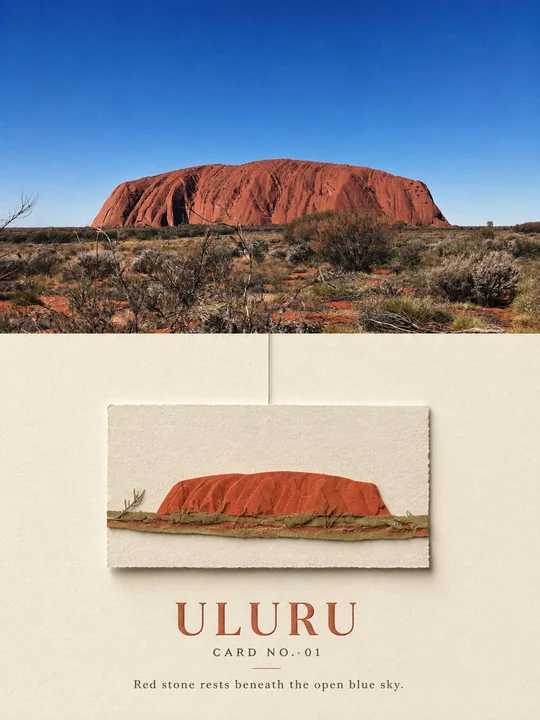
Please turn each travel photo I upload into an individual high-end design poster, with one photo corresponding to one finished product, and no collaging of multiple photos in the same frame. The overall layout uses a 3:4 vertical composition. The image consists of a clearly separated photography area and a paper art conversion area, with a straight, clear, and restrained horizontal boundary between the two areas, without blurred blending, tearing, infiltration, or material overlap. The upper photography area accounts for about 45%—50% of the entire image. Faithfully retain the identity, number, posture, direction, architectural structure, terrain relationship, observation angle, real material, natural light, and original color atmosphere of the subject in the original photo. Only perform slight travel magazine, independent publication, or photography exhibition-level color grading, and add very thin film grain. The upper part must remain a clearly identifiable real photograph and must not be changed into an illustration, and the subject must not be moved, replaced, mirrored, stretched, or redesigned. The lower part accounts for about 50%—55%, reconstructing the same scene as "SUSPENDED PAPER CARD TERRAIN". On warm off-white matte paper, suspend a small, open handmade paper card or terrain slice. The paper card occupies about 35%—50% of the lower area, located in the center, lower middle, or slightly offset according to the direction of the subject; about 40%—60% continuous blank paper surface is reserved around it. Use an extremely thin vertical suspension line, paper pin, or almost invisible suspension point to connect the paper card. The suspension line can only exist in the lower paper art area and must not enter the upper photo. The paper card is not a flat card printed with scenery. The core subject, roads, tracks, waterfronts, ridges, bridges, or steps in the photo should grow from the card's own slots, folded paper surfaces, and bas-relief layers. From the original photo, only extract: - One most recognizable subject or landmark; - One spatial clue that determines the scene's narrative; - Two to three layers of necessary terrain; - A small amount of plant, wave, vehicle, or human fragments as scale prompts. Actively delete, merge, and shrink complex environments, and do not replicate the entire photo in proportion. Express the structure through two or three layers of thin paper, continuous narrow cuts, shallow indentations, natural paper fibers, slight curls, open paper edges, and restrained short shadows. The paper art subject must retain the most critical outlines, directions, relative positions, and signature colors from the original photo, so that the viewer can still identify the original location at a glance. Extract 4-7 colors from the photo and soften them, with off-white paper occupying the main area, keeping only one most recognizable accent color. In the continuous white space outside the paper card, add: - An accurate title of 1—3 English words; - A "CARD NO. 01" style number; - A short observation sentence of 5—10 English words. The text must be determined word for word in advance. Use shallow debossing, letterpress, narrow serif, or restrained sans-serif fonts, as if crafted on a collection page with the paper card. The main title must be clearly readable at chat preview size; the auxiliary text can be smaller, but cannot be compressed into a blurry gray line. Overall temperament is light, quiet, poetic, and restrained, like a travel memory collected on paper by a thin line. Poeticism comes from scale, white space, paper, and a soft sense of gravity, rather than fairy tale characters or complex decorations. Avoid: small round planets, fairy tale asteroids, generic floating islands, complete realistic sandboxes, thick foam boards, plastic toys, smooth 3D, heavy shadows, dense paper-cut plants, busy scrapbook collages, redrawing the entire photo with different materials, proportional conversion of the same composition, missing original photos, photos shrunk into decorative thumbnails, blurry boundaries, suspension lines passing through photos, author names, book titles, quotes, logos, brands, URLs, watermarks, gibberish, and extra text. 请将我上传的每一张旅行照片分别制作成一张独立的高级设计海报,一张照片对应一张成品,不得将多张照片拼贴在同一画面中。 整体采用3:4竖版构图。画面由清楚分离的摄影区域与纸艺转绘区域组成,两个区域之间使用平直、清晰、克制的水平边界,不做模糊渐融、撕裂渗透或材质重叠。 上方摄影区域约占整张画面的45%—50%。忠实保留原始照片中的主体身份、数量、姿态、方向、建筑结构、地形关系、观察角度、真实材质、自然光线与原有色彩氛围。只进行轻微的旅行杂志、独立出版物或摄影展级调色,并加入极薄的胶片颗粒。上方必须仍然是一张清楚可辨的真实照片,不得改成插画,不得移动、替换、镜像、拉伸或重新设计主体。 下方约占50%—55%,将同一场景重新构建为“SUSPENDED PAPER CARD TERRAIN|悬挂纸卡微缩地形”。 在温暖的米白色哑光纸面上,悬挂一枚小型、开放式的手工纸卡或地形切片。纸卡占下方区域约35%—50%,位于中央、中下部或根据主体方向轻微偏置;四周保留约40%—60%的连续空白纸面。 使用一根极细的垂直悬线、纸钉或几乎不可见的悬挂点连接纸卡。悬线只能存在于下方纸艺区域,不得进入上方照片。 纸卡不是印有风景的平面卡片。照片中的核心主体、道路、轨道、水岸、山脊、桥梁或台阶,应从卡片自身的切槽、折起纸面和浅浮雕层叠中生长出来。 从原照片中只提取: - 一个最具识别度的主体或地标; - 一条决定场景叙事的空间线索; - 两至三层必要地形; - 少量植物、浪花、车辆或人物碎片作为尺度提示。 将复杂环境主动删除、合并和缩小,不要等比例复制整张照片。通过两三层轻薄纸片、连续窄切口、浅压痕、天然纸纤维、轻微翘角、开放纸边和克制的短投影表现结构。 纸艺主体必须保留原照片中最关键的轮廓、方向、相对位置和标志性色彩,使观者仍能一眼识别原地点。颜色从照片中提取4—7种并进行柔化,米白纸承担主要面积,只保留一处最具辨识度的强调色。 在纸卡之外的连续留白中加入: - 一个1—3个英文单词的准确标题; - “CARD NO. 01”式编号; - 一行5—10个英文单词的简短观察句。 文字必须提前逐字确定。使用浅凹压印、铅字、窄体衬线或克制无衬线字体,像与纸卡一起制作在收藏页上。主标题在聊天预览尺寸下必须清楚可读,辅助文字可以较小,但不能缩成模糊灰线。 整体气质轻盈、安静、诗意、克制,像被细线收藏在纸面上的旅行记忆。诗意来自尺度、留白、纸张和轻柔重力感,而不是童话角色或复杂装饰。 避免:圆形小星球、童话小行星、通用悬浮岛、完整写实沙盘、厚泡沫板、塑料玩具、光滑3D、重阴影、密集纸雕植物、繁忙手账拼贴、整张照片换材质重画、相同取景等比例转绘、原照片缺失、照片缩成装饰性缩略图、模糊分界、悬线穿过照片、作者名字、书名、引用、Logo、品牌、网址、水印、乱码和额外文字。


生成一张高完成度、收藏级、史诗叙事感的艺术海报,主题为【黑神话 × 李清照】 【核心构图】 采用“双重曝光式剪影叙事构图 + 双人物对照结构”: 画面由两位人物的侧脸剪影共同构成整体轮廓,呈对称或交错构图—— 左侧为:神话战斗体系人物(类黑神话风格的妖神/斗战者),轮廓刚硬、破碎、燃烧感强,气质桀骜、野性、压迫感强; 右侧为:李清照,宋代女词人形象,轮廓柔和、清冷克制,气质孤独、温婉而哀伤。 两人之间形成强烈对比:**神性 vs 人性、暴烈 vs 克制、战斗 vs 情感