Case 25846
بوستر بأسلوب تحرير يجمع بين التصوير الفوتوغرافي الوثائقي والنحت البارز اليدوي في الخشب
Prompt
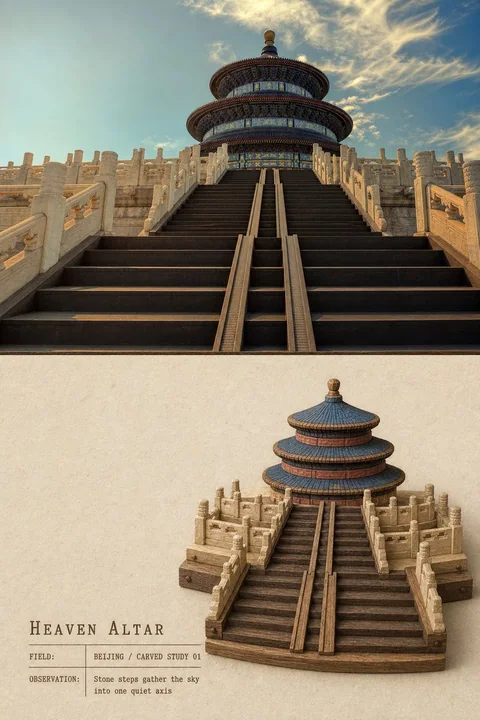
Please turn every travel photo I upload into an independent 3:4 vertical editorial poster, outputting each photo separately without any multi-image tiling.

The top half retains the original photo, occupying about 50% of the frame. Accurately maintain the architectural identity, structural relationships, observation angles, real textures, natural light and shadow, and original color atmosphere in the photo. Only perform slight high-end photography color grading and extremely thin film grain processing. The top half must remain a clearly identifiable real photo; do not illustrate, redraw, move, distort, mirror, or replace the buildings.

The bottom half extracts the most recognizable architectural outlines, eaves, steps, bridges, water surfaces, rocks, or road relationships from the same photo, reconstructing them into a hand-carved wood-carving memory relief.

Do not overlay a wood-grain filter on the original photo, nor make it a smooth plastic 3D model. Use basswood, beech, light walnut, and a small amount of colored wood pieces to simulate real cork carving, stacked wood pieces, and low-shallow bas-relief. Use wood pieces of different thicknesses to reorganize different elements, expressing rounded hand-carved edges, visible wood grain, seams, tenon points, thin wood strips, slight misalignments, chiseled gaps, partial edge chipping, and natural short studio shadows.

The bottom half adopts a physical structured composition; do not copy the complete framing of the original photo. Keep only 2 to 4 of the most important architectural structures and a small amount of supporting spatial relationships, compressing the main subject into a compact wood-carved memento. The environment can be summarized as three to five layers of curved, polyline, or stepped wood pieces. The model occupies about 50% to 65% of the bottom half, with at least 35% continuous warm ivory paper whitespace around it, especially reserving a quiet area for text.

Colors are mainly natural wood tones, including basswood light yellow, beech warm brown, light walnut, and dark wood colors. Extract no more than three low-saturation accent colors from the original photo for roofs, walls, clothing, water surfaces, or architectural decorations. Do not use rainbow wood pieces, bright lacquer, high-saturation colors, or uniform fixed color schemes.

Add a small amount of readable mediated text in the whitespace area of the bottom half:
Main Title: "[1–3 word English title]"
Material Field: "[Location or Subject] / CARVED STUDY [Number]"
Observation Sentence: "[A short sentence describing a truly visible structure, action, or spatial relationship in the photo]"

Text should be like embossing, branding, woodcut type, or hand typography, becoming part of the paper or wood pieces. Use narrow serif or restrained humanist sans-serif fonts, dark wood color, few words and clear. Do not generate author names, signatures, logos, websites, QR codes, fictional dates, fictional coordinates, fake Chinese, garbled code, or watermarks.

Overall temperament:
hand-carved wood relief, stacked wood pieces, tactile memory object, carved travel keepsake, shallow bas-relief, visible wood grain, rounded chisel edges, handmade joinery, warm ivory paper, quiet editorial composition, museum craft object, restrained Chinese architectural memory.

Avoid:
wood-texture photo filter, smooth CGI, plastic toy, glossy lacquer, thick solid wooden slab, full scenic diorama, dense miniature details, complete background rendering, invented architecture, changed source photo, same-crop redraw, missing original photo, fake text, author name, logo, watermark, extra people, excessive shadows, edge-to-edge composition.
مطالب أخرى
Case 28604
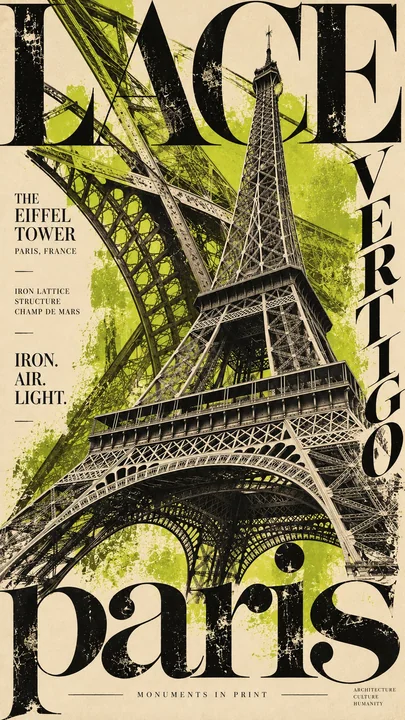
بوستر فني بتخطيط نصي لمعلم معماري تجريبي
LANDMARK: [Iconic architectural landmark] LOCATION: [City, Country] PRIMARY COLOR: [Chartreuse / Raspberry / Teal / Wine Plum] TOP HEADLINE: [Short expressive English word] SIDE TYPOGRAPHY: [Architectural or conceptual word] BOTTOM TITLE: [
Case 9201
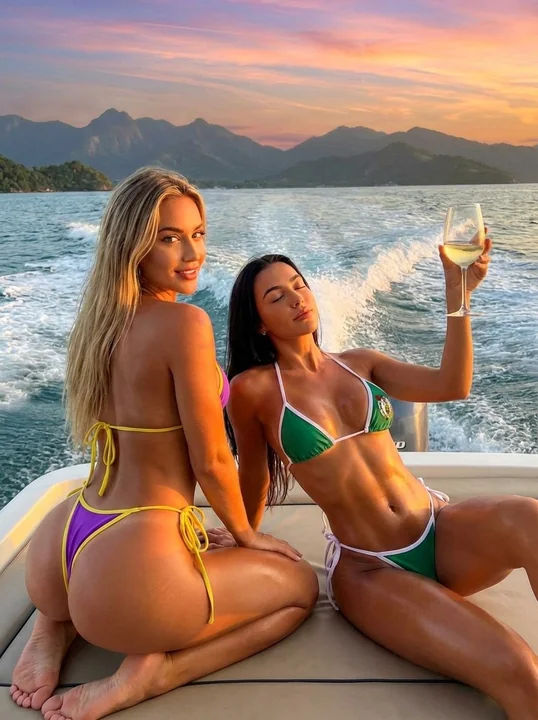
سياحية يخت بикиني شمسية مذهلة
{ "subject": { "description": "صورة رأسية تُظهر امرأتين شابتين لهما أجسام مذهلة يرتديان ملابس سباحة شفافة، جالستين على مؤخرة قارب أثناء رحلة سفاري ممطرة بجمال غروب الشمس.", "body": { "physique": "كلتا السيدتين تمتلكان أجساماً مُشكّلة بشكل م
比基尼游艇曲线美辣妹晚霞