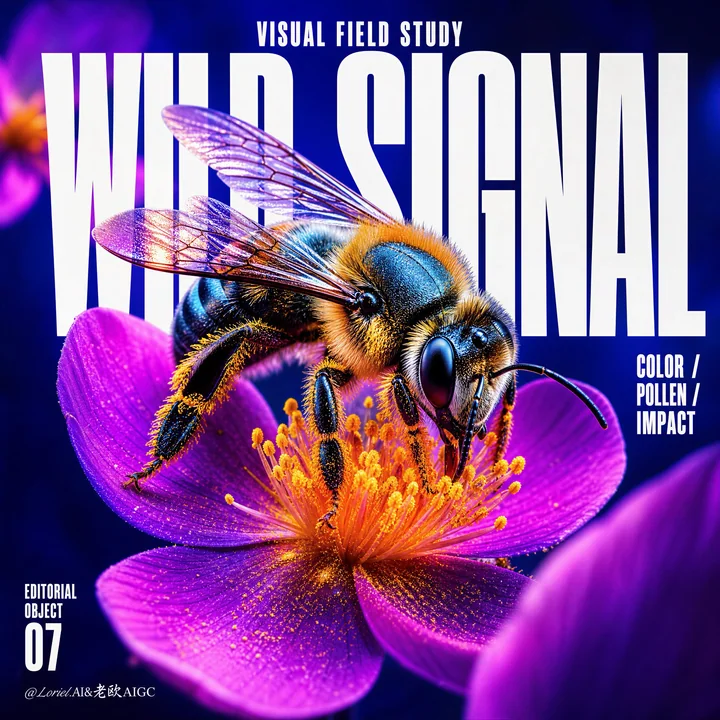
Create an ultra-detailed macro poster built around one fixed iconic visual system: a neon-lit pollinating insect suspended over a saturated flower core, a giant white condensed title embedded behind the subject, and a deep cobalt-to-ultraviolet background with soft floral bokeh. Use premium commercial macro-photography aesthetics with extreme micro-texture detail, controlled high saturation, and sharp editorial poster hierarchy.
Core composition:
vertical poster layout, one bee-like pollinator positioned slightly above the flower center, body angled diagonally from upper-left toward lower-right, legs gripping the stamens, wings partially open. A large five-petal magenta-violet flower occupies the lower-middle and central frame. One oversized blurred petal mass enters from the lower-right foreground, and one soft out-of-focus bloom enters from the upper-left background. The insect and flower core remain the sharp focal zone. Place one huge condensed white uppercase headline across the upper-middle to center background, partially obscured by the insect and flower, functioning as a structural design block.
Port logic:
turn this composition into the unmistakable super-symbol of the poster series. The permanent identity must be built from four fixed codes: one hyper-detailed pollinating insect, one glowing central flower core, one giant white title block behind the subject, and one deep blue-violet macro background with soft floral blur. The image should feel instantly ownable, repeatable, and scalable across a full visual series by changing only the insect species and flower type.
Orbit logic:
build a strong closed visual loop across the poster. The eye should move from the giant white headline into the insect head and antennae, travel across the luminous thorax fur and front legs, drop into the pollen-rich flower center, sweep across the lower petals and foreground blur, then rise back through the insect wing and body contour into the title block again. The antennae, leg placement, pollen dust, stamen direction, wing angle, and petal framing must all reinforce one continuous circulation path.
Typography structure:
retain text as a compositional object, not as editorial article text. Use original wording only.
Main title:
WILD SIGNAL
Top small line:
VISUAL FIELD STUDY
Side micro lines:
COLOR / POLLEN / IMPACT
Bottom-left small block:
EDITORIAL OBJECT 07
All text must feel bold, white, condensed, and integrated behind the subject.
Subject design:
use a bee-like pollinator with dense visible thorax fur, segmented abdomen, iridescent cyan-blue and warm amber transitions across the body, translucent pink-lilac wings, articulated legs coated with pollen grains, sharply defined antennae, glossy compound eyes, and visible mouthparts contacting the flower center. The anatomy must remain biologically coherent and physically believable.
Flower design:
use one five-petal blossom in saturated pink-violet with a dense central stamen cluster in hot orange-yellow. Petal surfaces should show powdery pollen dust, subtle translucency at thinner edges, fine veining, and tiny reflective particles. The flower must visually anchor the lower half of the poster.
Lighting:
soft but directional macro lighting from upper-left front, with strong chromatic separation. Main highlights should strike the insect thorax, eye edge, antennae, wing membrane, and upper petals. Add a secondary cool fill from the right to preserve blue-violet shadow information. Maintain readable shadows, high luminous contrast, and no crushed blacks.
Color system:
dominant deep electric blue and ultraviolet background, saturated magenta-violet petals, hot yellow-orange pollen, cyan-blue reflective accents on the insect, and pure white typography. Maintain strong warm-cool separation and high saturation without muddy blending.
Materials and texture:
extreme macro detail on insect fur, pollen grains, wing veins, petal dust, flower filaments, and micro-reflections. Preserve realistic subsurface scattering in petals, translucent wing physics, and granular pollen buildup on legs and flower center. Everything must obey real optical macro-photography behavior.
Depth of field:
very shallow macro depth of field. The insect head, thorax, front legs, and central stamens must be critically sharp. Foreground petals, background petals, and outer wing edges should soften progressively with premium optical falloff.
Style and rendering:
hyper-real macro photography fused with bold editorial poster graphics, neon botanical design language, premium poster finish, no flat illustration, no cartoon simplification, no low-detail CGI look. Keep the image dense, sharp, luminous, and tightly controlled.
Background:
deep cobalt-blue to violet gradient with soft abstract bokeh bloom and diffused floral blur only. No landscape, no extra environment, no clutter.
Image quality and physical constraints:
8k poster clarity, razor-sharp focal subject, clean typography edges, realistic insect anatomy, realistic pollen behavior, no extra legs, no broken wings, no muddy shadows, no black blotches, no unreadable text mass, no duplicated petals, no random debris, no watermark.
Negative prompt:
cartoon insect, flat illustration, low-detail fur, broken legs, extra legs, fused limbs, distorted wings, muddy neon, dead black background, unreadable headline, cluttered composition, weak flower center, washed-out pollen, plastic petal texture, low resolution, watermark, copied wording.
创建一个围绕一个固定的标志性视觉系统构建的超详细微距海报:一个悬浮在饱和花芯上方的霓虹照明传粉昆虫,一个嵌入在主体后面的巨型白色紧致标题,以及一个带有柔和花卉虚化的深钴蓝色至紫外线背景。使用具有极端微观纹理细节、受控的高饱和度和锐利编辑海报层级的优质商业微距摄影美学。
核心构图:
垂直海报布局,一只类似蜜蜂的传粉者位于花朵中心略上方,身体从左上向右下呈对角线倾斜,腿部抓握雄蕊,翅膀部分张开。一朵巨大的五瓣品红紫色花朵占据中下部及中心框架。一团超大的模糊花瓣从右下角前景进入,一朵柔和的失焦花卉从左上角背景进入。昆虫和花芯保持锐利的焦点区域。在背景中上部至中心横放一个巨大的紧致白色大写标题,部分被昆虫和花朵遮挡,作为结构性设计块发挥作用。
接口逻辑:
将此构图转化为该海报系列中辨识度极高的超级符号。永久身份必须由四个固定代码构建:一只超详细的传粉昆虫,一个发光的中央花芯,一个位于主体后面的巨型白色标题块,以及一个带有柔和花卉模糊的深蓝紫色微距背景。图像应感觉立即可识别、可重复,并能通过仅更改昆虫种类和花卉类型在整个视觉系列中扩展。
轨道逻辑:
在海报上建立一个强大的封闭视觉循环。视线应从巨型白色标题移动到昆虫的头部和触角,穿过发光的胸部细毛和前腿,落入富含花粉的花芯,扫过下方的花瓣和前景模糊,然后再次通过昆虫翅膀和身体轮廓升回标题块。触角、腿部摆放、花粉尘、雄蕊方向、翅膀角度和花瓣构图都必须强化一条连续的流通路径。
排版结构:
保留文本作为构图对象,而非编辑文章文本。仅使用原始措辞。
主标题:
WILD SIGNAL
顶部小字:
VISUAL FIELD STUDY
侧面微型行:
COLOR / POLLEN / IMPACT
左下角小块:
EDITORIAL OBJECT 07
所有文本必须感觉大胆、白色、紧致,并融合在主体之后。
主体设计:
使用一只具有密集可见胸部细毛、分节腹部、遍布全身的虹彩青蓝色和温暖琥珀色过渡、半透明粉紫丁香色翅膀、涂有花粉粒的关节腿、定义清晰的触角、光滑复眼以及与花心接触的可见口器的类蜂传粉者。解剖结构必须保持生物学上的连贯性和物理上的可信度。
花卉设计:
使用一朵饱和粉紫色的五瓣花,中心有密集的橙黄色雄蕊群。花瓣表面应显示出粉状花粉尘、较薄边缘处微妙的半透明感、细致的脉络以及微小的反射颗粒。花朵必须在视觉上固定海报的下半部分。
光照:
来自左上前方的柔和但有方向性的微距照明,具有强烈的色彩分离。主要高光应击中昆虫胸部、眼睛边缘、触角、翅膀薄膜和上部花瓣。从右侧添加辅助冷光填充,以保留蓝紫色阴影信息。保持可读的阴影、高亮度对比,且无死黑。
色彩系统:
主导的深电蓝和紫外线背景,饱和的品红紫色花瓣,亮黄橙色花粉,昆虫上的青蓝色反射亮点,以及纯白色排版。保持强烈的冷暖分离和高饱和度,无浑浊融合。
材料与纹理:
昆虫细毛、花粉粒、翅脉、花瓣尘、花丝和微反射上的极端微距细节。保留花瓣中真实的次表面散射、半透明的翅膀物理特性,以及腿部和花芯上的颗粒状花粉堆积。一切必须遵循真实的微距摄影光学行为。
景深:
极浅的微距景深。昆虫头部、胸部、前腿和中央雄蕊必须极其锐利。前景花瓣、背景花瓣和翅膀外缘应随着优质的光学衰减逐渐柔化。
风格与渲染:
超现实微距摄影与大胆的编辑海报图形相结合,霓虹植物设计语言,优质海报质感,无扁平插画,无卡通简化,无低细节 CGI 外观。保持图像密集、锐利、明亮且受到严格控制。
背景:
深钴蓝色到紫色的渐变,仅带有柔和的抽象焦外散景和扩散的花卉模糊。无景观,无额外环境,无杂乱。
图像质量和物理约束:
8k 海报清晰度,极其锐利的焦点主体,干净的排版边缘,真实的昆虫解剖,真实的花粉行为,无额外的腿,无破损的翅膀,无浑浊的阴影,无黑斑,无难以阅读的文本块,无重复的花瓣,无随机碎屑,无水印。
负面提示词:
卡通昆虫,扁平插画,低细节细毛,断腿,多余的腿,融合肢体,扭曲的翅膀,浑浊的霓虹,死黑背景,难以阅读的标题,杂乱构图,虚弱的花芯,褪色的花粉,塑料花瓣纹理,低分辨率,水印,复制的文字。
Model: ChatGPTSourceUpdated: 9/2/2026, 10:40:13 AM